
Why Is Co Renting Becoming More Popular in Australia?
Co renting is becoming more relevant because sharing accommodation can reduce the cost of housing and make well-located suburbs more accessible. Instead of paying for an entire dwelling, residents can share household expenses. This arrangement may suit people who need affordable accommodation close to employment, education and transport.
How Does Co Renting Help With Rising Housing Costs?
A person renting independently generally covers the full cost of their accommodation, including rent, electricity, internet and other household expenses.
Sharing a property allows residents to divide some of those costs.
According to the Australian Bureau of Statistics’ latest Consumer Price Index release Australian Bureau of Statistics’ housing inflation data, rental prices rose 3.6% in the 12 months to September 2026, making rent a significant contributor to household living expenses.
For renters managing limited budgets, co renting may offer access to areas where an entire apartment or house would otherwise be unaffordable.
However, sharing accommodation doesn’t eliminate rental pressure. Residents still need to consider their total housing costs, including transport, utilities and any services excluded from the advertised rent.
Why Does Australia’s Housing Shortage Matter?
Australia’s housing supply challenges are also influencing accommodation choices.
The National Housing Supply and Affordability Council’s assessment of Australia’s housing system examines the relationship between housing availability, construction activity and affordability.
When suitable homes are difficult to find, residents may consider sharing existing accommodation rather than competing for entire properties.
This creates a need for shared rental accommodation that balances affordability with privacy, safety and everyday convenience.
For investors exploring alternative property strategies, this gap between what renters need and what traditional share houses offer is where purpose-designed co-living can play a role.
What Is the Difference Between Co Renting and Co-Living?
Co renting generally means sharing a rental property and its associated expenses, often under a joint lease. Co-living is a housing model designed around private accommodation and shared facilities. Although both involve communal living, purpose-designed co-living can offer greater privacy, more suitable layouts and clearer arrangements for individual residents.
Traditional co renting typically involves several people occupying an ordinary house or apartment. Residents may share bathrooms, kitchens, household bills and cleaning responsibilities.
Co-living properties are designed or adapted specifically for shared occupancy. They may include private ensuites, furnished bedrooms, secure personal spaces and communal facilities suited to multiple residents.
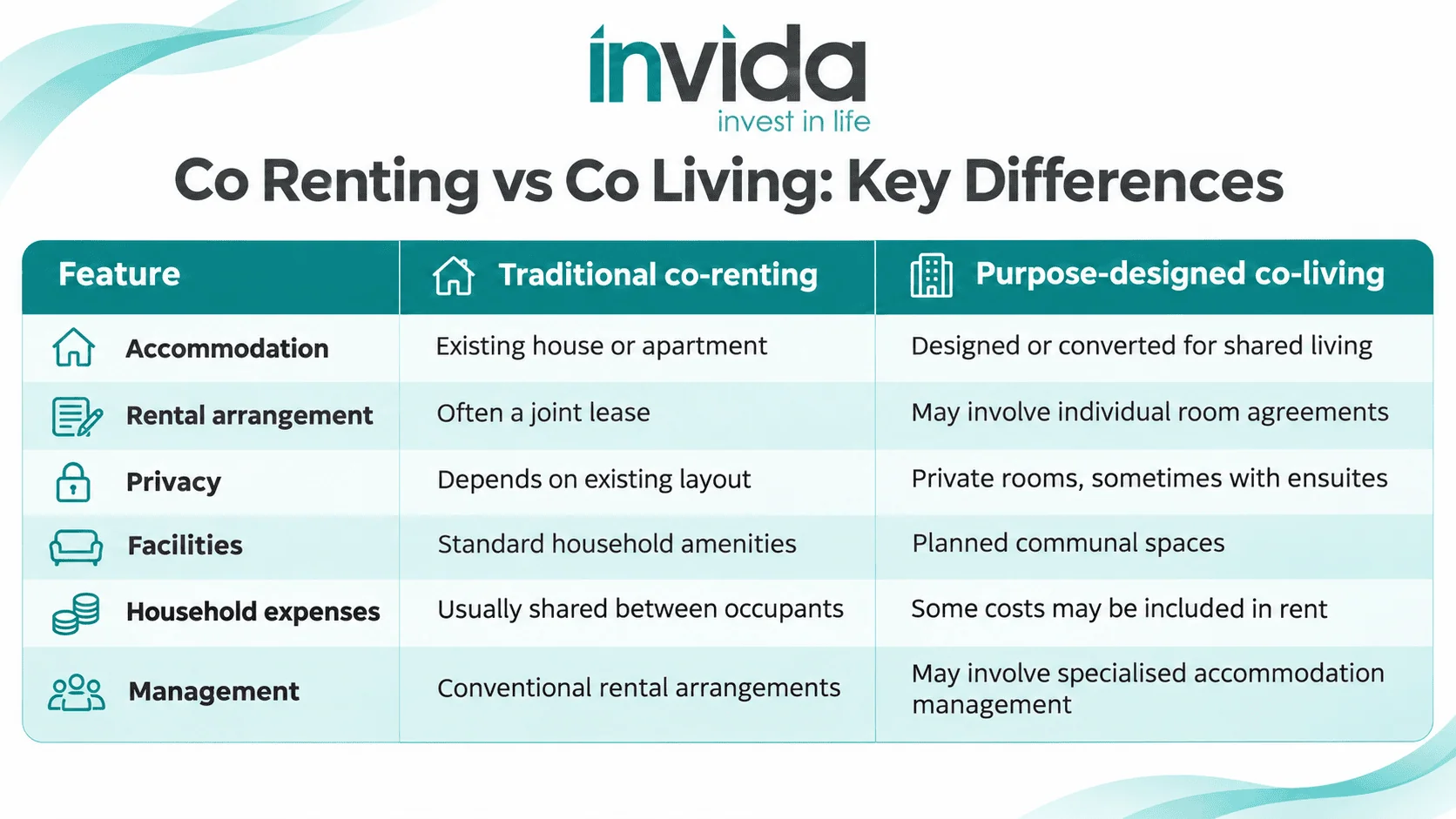
These are common characteristics rather than fixed legal definitions. The applicable rules depend on the property’s location, occupancy and actual use.
Why Might Purpose-Designed Co-Living Be More Suitable?
A conventional house may have enough bedrooms for several adults but insufficient bathrooms, storage or communal space.
Different work schedules can also create practical problems when residents share limited facilities.
Purpose-designed co-living seeks to reduce these compromises through appropriate room layouts, acoustic separation, secure bedrooms and suitable shared amenities.
For example, a resident working night shifts may benefit from a private ensuite and better sound insulation.
The advantage isn’t simply accommodating more people. It’s providing housing that better supports independent residents sharing one property.
For more information about the broader housing need, explore INVIDA’s discussion of Australia’s housing shortage and how co-living accommodation can help.
Is Co-Living More Affordable Than Renting an Entire Property?
Co-living can be more affordable when someone needs only a private room rather than an entire home. However, the actual saving depends on location, weekly rent and included services. Residents should compare their total accommodation expenses, including utilities, furnishings, transport and shared facilities, before deciding which option provides better value.
A furnished co-living room may reduce the need to purchase furniture or arrange separate utility accounts.
However, some properties include these services in the advertised rent while others charge separately.
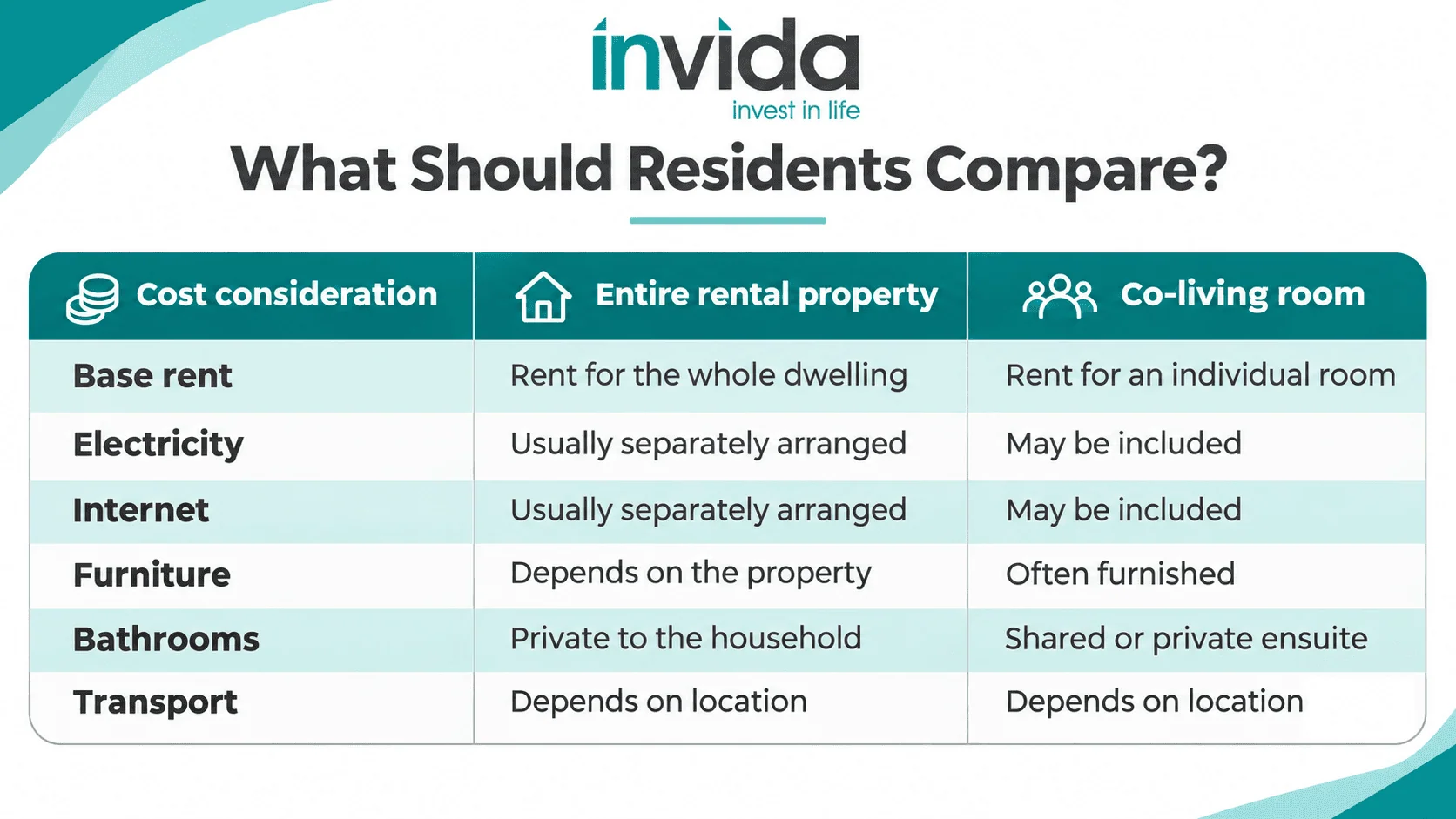
The right choice depends on total weekly costs and the resident’s preferences.
This distinction matters because co renting may reduce household expenses without necessarily providing the same convenience or privacy as a suitable co-living property.
For property owners, this is why demand for private-room accommodation is worth understanding. Renting rooms to individual residents creates a different income structure from leasing a whole house to one household, but it also brings different management, compliance and maintenance responsibilities.
How Do Co-Living Rules Differ Across VIC, NSW, QLD and WA?
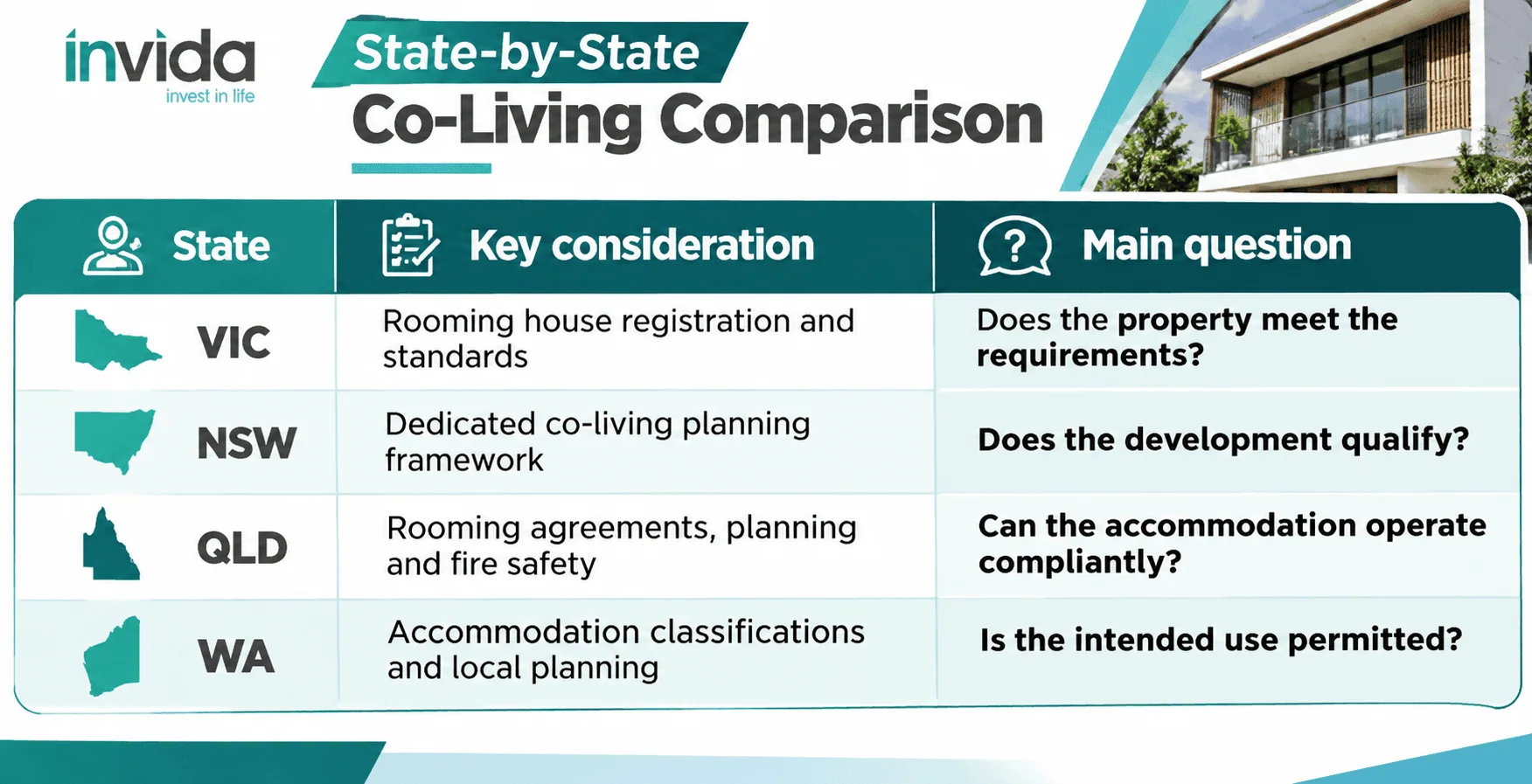
Co renting and co-living are subject to different legal requirements depending on the state, property configuration and tenancy arrangements. A conventional shared lease may be regulated differently from rooming accommodation. Before establishing or occupying a co-living property, the relevant planning, building, tenancy and fire-safety obligations should be confirmed.
Victoria: What Rules Apply to Rooming Houses?
Victoria regulates rooming houses separately from conventional shared rental properties.
A rooming house generally involves accommodation where four or more people can occupy rented rooms.
The Victorian rooming house minimum standards address privacy, safety, security and amenity.
Rooming houses must be registered with the local council, and operators must hold a rooming house operator licence.
Conventional co renting may be more practical where a property doesn’t meet the requirements for rooming accommodation.
Purpose-designed co-living may be suitable where the property can satisfy the relevant standards and provide appropriate facilities for residents.
New South Wales: How Is Co-Living Regulated?
NSW has a dedicated planning category for larger, purpose-built co-living developments.
Under the NSW Government’s co-living housing framework, qualifying developments must meet requirements for private rooms, communal facilities, ongoing management and minimum tenancy periods.
The framework is intended for residential accommodation rather than short-term tourist stays.
Smaller shared homes may instead be assessed under other residential or rooming arrangements, depending on how the property is configured and used.
Purpose-designed co-living may be appropriate where the property and proposed development meet the relevant planning requirements.
Queensland: What About Brisbane and the 2032 Olympics?
Queensland’s housing needs are influenced by population changes, employment opportunities and major infrastructure projects.
The Brisbane 2032 Olympic and Paralympic Games may contribute to accommodation demand associated with construction and related employment.
However, long-term housing suitability should not be assessed solely around a temporary event.
Queensland also has specific rooming accommodation arrangements.
The Queensland Residential Tenancies Authority’s Form R18 addresses agreements between rooming accommodation providers and residents.
Property use, building classification, fire safety and applicable planning requirements require separate consideration.
These issues are particularly relevant when comparing an ordinary shared tenancy with purpose-designed accommodation for unrelated residents.
Western Australia: What Rules Apply in Perth?
Western Australia distinguishes between several residential accommodation arrangements.
The WA Government’s guidance on boarders and lodgers explains that rights and responsibilities can depend on the type of accommodation, services provided and agreement between the parties.
Local planning schemes may also affect whether a property can operate as room-based accommodation.
Traditional co renting may be suitable where a conventional residential tenancy meets residents’ needs.
Co-living may be appropriate where the accommodation arrangement and property use satisfy applicable requirements.
What Building Rules Apply Across All States?
Building requirements also need attention.
Under the National Construction Code, different forms of shared accommodation may fall within Class 1b, Class 3 or another relevant classification.
A tenancy agreement or planning approval does not automatically establish compliance with every building and fire-safety requirement.
What Makes a Property Suitable for Co-Living?
A suitable co-living property needs more than several bedrooms. It should support privacy, safe movement, practical shared facilities and an appropriate number of residents. Location, building configuration, applicable approvals and ongoing management also matter. A home that works well for one household may need substantial changes before accommodating independent residents comfortably. For investors, this assessment is best done before purchasing or converting a property, as layout, approvals and upgrade costs all shape whether a co-living project is practical.
Before committing to a conversion, it’s also worth understanding what can make a property unsuitable for co-living, including restrictive layouts, inadequate parking, planning limitations and costly structural modifications.
What Should Be Checked Before Establishing Co-Living Accommodation?
Key considerations include:
- Location: Access to employment, education, healthcare and transport.
- Privacy: Secure bedrooms, suitable bathrooms and acoustic separation.
- Shared facilities: Appropriate kitchens, laundries, storage and communal areas.
- Safety: Applicable building classification, exits and fire protection.
- Approvals: Planning permissions, building requirements and other relevant obligations.
- Management: Clear responsibilities for maintenance, shared spaces and resident arrangements.
Some existing homes may accommodate a suitable conversion.
Others may require substantial alterations or a purpose-built design to provide appropriate facilities.
The suitability of any property should be assessed individually rather than assuming that adding bedrooms automatically creates compliant co-living accommodation.
Explore Purpose-Designed Co-Living With INVIDA
Australia’s housing affordability pressures are encouraging people to reconsider how much space they need and how they share accommodation costs.
Traditional co renting remains a practical option, but purpose-designed co-living can offer greater privacy, better facilities and accommodation more closely suited to independent residents.
At INVIDA, we recognise that successful co-living starts with understanding the property, the people who will occupy it and the requirements that apply.
Explore INVIDA’s approach to co-living accommodation and learn how thoughtful property design can help address Australia’s changing housing needs. Then book a strategy call below to discuss whether co-living property investment suits your goals.