What Is Dual Occupancy and How Does It Differ From Co-Living?
In most cases, dual occupancy involves providing two dwellings on one parcel of land. Depending on the state, council, zoning and design, those dwellings may be attached or detached and may potentially have subdivision opportunities.
Each residence is generally self-contained, with its own kitchen, bathroom, bedrooms and living facilities.
Co-living works differently.
Instead of using the site to provide two complete homes, a co-living property is configured to provide several private rooms or suites supported by appropriate communal facilities. Residents generally rent their individual accommodation separately.
For an investor, this changes the income model considerably.
A two-dwelling property normally produces two rental streams. A co-living investment might provide four, five or more individually rented spaces, depending on the approved configuration, property design and rules that apply at that address.
This can make co-living particularly attractive to investors seeking a high-yield property investment rather than relying predominantly on capital growth.
However, higher potential income does not mean every co-living property will outperform. Purchase price, conversion costs, vacancy, property management, utilities, maintenance and local resident demand all need to be considered.
Dual Occupancy vs Co-Living: What Are the Pros and Cons?
Both strategies have legitimate advantages. Understanding them helps investors decide which outcome they are actually trying to achieve.
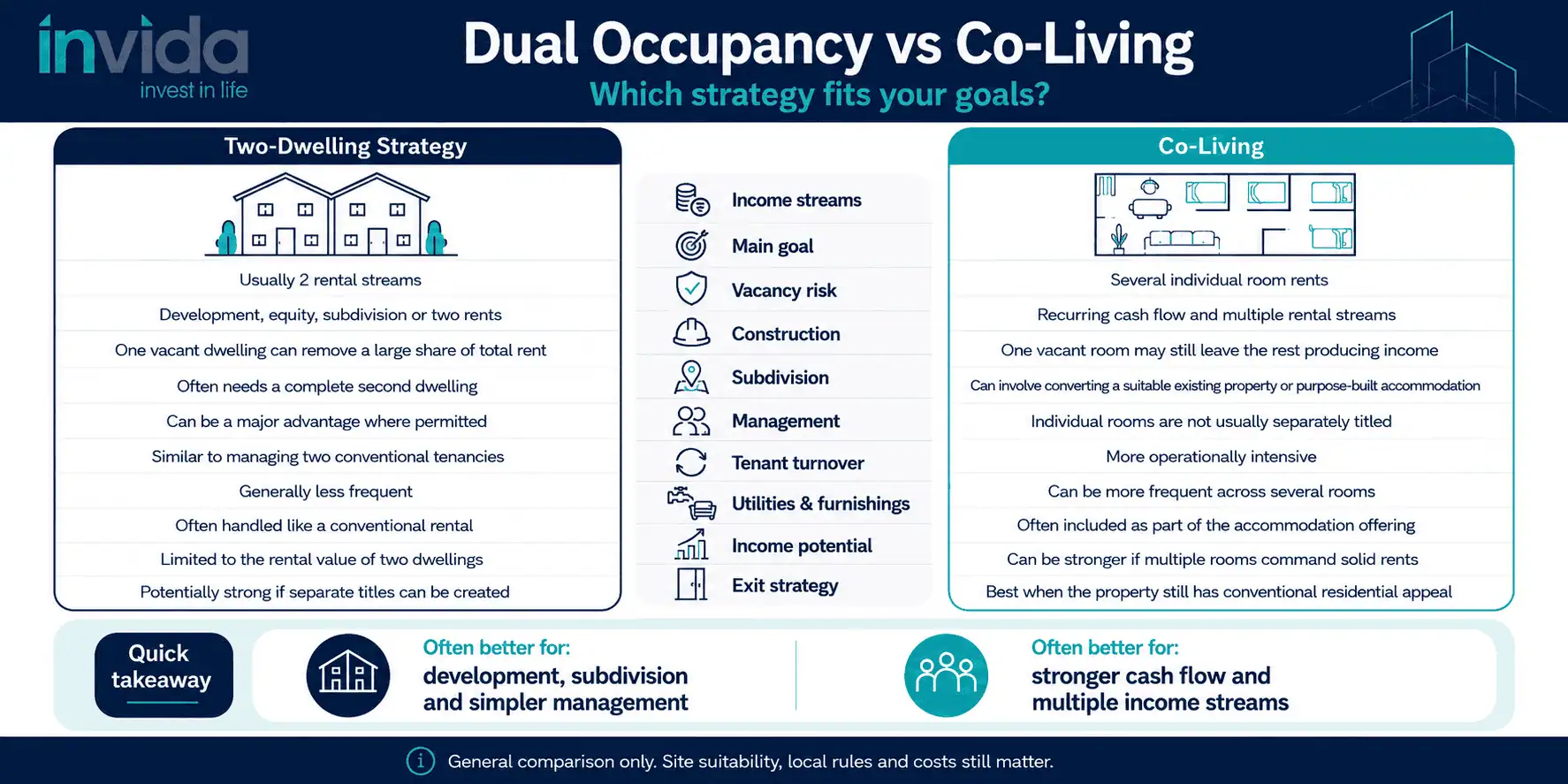
Neither option automatically wins.
The right property investment strategy depends on the location, total capital required, planning pathway, income objective and investor’s longer-term exit plan.
Where a Two-Dwelling Strategy Can Be Stronger
There are situations where creating two separate residences deserves serious consideration.
A property with suitable frontage, development potential and a realistic subdivision pathway may allow an investor to manufacture equity rather than simply increase rental income.
Depending on the applicable rules, an investor may eventually be able to sell one property and retain the other, sell both separately or use the additional equity for another investment.
Management can also be simpler.
Managing two conventional tenancies will generally involve fewer individual residents, fewer leases and fewer shared-space considerations than operating a five-room co-living property.
If the investor’s objective is development profit, separate titles or a simpler conventional tenancy model, these advantages should not be ignored.
Where Co-Living Can Be Stronger
Co-living becomes particularly compelling when the right existing property can be converted efficiently without constructing an entirely separate residence.
It also spreads income across several residents.
Imagine a property producing five separate room rents. If one room becomes temporarily vacant, four income streams can remain.
Compare that with a property containing only two tenancies. Losing one tenant can remove a much larger portion of the property’s total income.
Co-living can also make more productive use of larger residential properties that may otherwise provide relatively modest yields as conventional rentals.
A large house with the right bedrooms, wet areas, communal spaces and access to employment, transport and services can sometimes generate considerably more rental income when configured and managed specifically for co-living.
Why INVIDA Generally Prefers Co-Living for Cash-Flow Investors
From INVIDA’s perspective, dual occupancy is strongest when an investor is deliberately pursuing a development, subdivision or two-residence outcome. When the primary objective is recurring cash flow, however, we generally see greater potential in a carefully selected co-living property.
The reason is relatively straightforward.
Instead of relying on one or two rental streams, investors have the potential to receive income from several individually rented spaces.
But the words carefully selected matter.
We would not recommend buying any large house simply because it has enough bedrooms on the floorplan.
Some properties are expensive to convert. Others have poorly positioned wet areas, insufficient communal space, difficult parking, planning constraints or layouts that require so much structural work that the financial advantage disappears.
The suburb may also be wrong.
A beautifully converted five-room property will not deliver the required result if there is insufficient local demand for room-by-room accommodation.
The strongest INVIDA opportunities therefore start with acquisition due diligence rather than renovation plans after the property has already settled.
Why Location Changes the Dual Occupancy vs Co-Living Decision

Australia does not have one national co-living planning framework.
Similar accommodation can be described and regulated differently depending on where the property is located. NSW has a specific planning category for co-living housing. Queensland commonly uses the term rooming accommodation. Victoria has rooming house requirements, while Western Australia combines statewide residential design rules with local council planning and lodging-house requirements.
These distinctions are important.
An investor should never assume that a co-living configuration operating successfully in Brisbane can simply be duplicated in Melbourne, Sydney or Perth.
The intended number of occupants, building design, zoning, local planning scheme, building classification and operating model all need to be checked for the individual property.
Dual Occupancy vs Co-Living in Victoria
Victoria can provide opportunities for both approaches, particularly where an existing property is well suited to conversion.
For two-home developments, Victoria has introduced a faster assessment pathway for qualifying projects.
The Victorian Government states that eligible applications for two homes on a lot can use the planning process for two homes on a lot. Where all applicable requirements are met, the process can provide a decision within 10 business days. Other controls, including heritage or flooding controls, can make an application ineligible for the streamlined pathway.
This makes dual occupancy potentially attractive where the investor has a suitable residential site and the objective is creating a second dwelling.
For co-living investors, rooming house requirements are equally important.
Consumer Affairs Victoria states that rooming house operators must comply with Victoria’s rooming house minimum standards covering matters including privacy, security, safety and amenity. The standards include requirements affecting bathrooms, entrances, security, laundry facilities and the general condition of the property.
What INVIDA Would Look for in Victoria
For an INVIDA-style investment, an existing property with a suitable floorplan can be particularly interesting if it can be converted without substantial structural work.
We would look closely at:
- existing bedroom sizes and locations
- proximity of bedrooms to plumbing
- capacity to add appropriate bathroom facilities
- usable communal living areas
- parking and access
- fire and building compliance requirements
- local demand for room-by-room accommodation
whether the property can retain conventional residential appeal
A house requiring extensive reconstruction simply to create enough rentable rooms may not be the best choice, even in an otherwise desirable Melbourne location.
Dual Occupancy vs Co-Living in Queensland
Queensland provides one of the most interesting current comparisons for investors.
The Queensland Government currently has provisions allowing qualifying small-scale rooming accommodation in lower-density residential zones to avoid material-change-of-use planning approval where the prescribed requirements are satisfied.
The provision applies to small-scale accommodation with a maximum of five bedrooms and five occupants.
Importantly, the Queensland Government states that these provisions currently expire on 2 December 2026.
That date matters for anyone currently evaluating a property.
The current rules should not be assumed to remain unchanged for a project that will depend on a planning pathway after December 2026. Investors need to check the rules applying at the time their particular project is undertaken.
Brisbane provides an additional local example.
Brisbane City Council identifies rooming accommodation for a maximum of five guests in Low Density Residential, Character Residential, Low-Medium Density Residential and Medium Density Residential zones, subject to applicable requirements.
Compare this with a two-dwelling proposal.
Brisbane City Council states that a dual occupancy development requires planning assessment as either code assessable or impact assessable. Even a code-assessable development requires a development application and planning approval before development begins.
This creates circumstances where a compliant five-resident co-living property may have a particularly attractive planning pathway on an appropriate Brisbane site.
There can also be additional operational requirements.
Where an arrangement constitutes a residential service under Queensland legislation, operators may face registration and accreditation obligations. Business Queensland provides further guidance on requirements for residential service operators.
What INVIDA Would Look for in Queensland

Queensland remains an important co-living market, but we would look beyond suburb-level demand.
Before acquiring a property, we would want to understand:
- the precise zone
- the intended number of residents
- whether the current small-scale planning provisions apply
- what happens if the development occurs after 2 December 2026
- building and fire-safety requirements
- plumbing and drainage requirements
- parking
- property layout
- resident demand
- total conversion cost
Buying a property because somebody says “five-bedroom co-living is allowed in Queensland” is not enough.
The approval pathway needs to work for the actual address and proposed use.
Dual Occupancy vs Co-Living in New South Wales
New South Wales is particularly important because its statutory co-living framework is different from the smaller rooming-accommodation models commonly seen elsewhere.
The NSW Government has a defined planning category called co-living housing.
Under the state’s Housing SEPP rules for co-living housing, a co-living development must contain at least six private rooms. It must also provide indoor and outdoor communal areas, serve as residents’ primary place of residence and have a manager responsible for implementing the property’s management plan. Development consent is required.
That distinction is important for an investor accustomed to seeing four or five-room co-living properties in other states.
The same configuration cannot automatically be described or treated as statutory NSW co-living housing.
At the same time, NSW has made two-home development more widely available.
The NSW Government’s Low and Mid-Rise Housing Policy states that Stage 1 commenced on 1 July 2024 and permitted dual occupancies and semi-detached homes in R2 Low Density Residential zones across NSW.
This can make dual occupancy particularly worth investigating on an appropriate NSW R2 property where the objective is to create two complete residences.
What This Means for Co-Living Investors in NSW
We would not try to force a Queensland or Victorian model onto a NSW property.
Instead, the planning pathway needs to be established first.
An investor considering co-living in NSW should understand exactly how the proposed accommodation will be classified, whether the statutory co-living provisions apply and what development consent, design and management requirements will result.
This is an example of a market where the property may look suitable physically but still be a poor investment choice if its intended configuration does not fit an appropriate planning pathway.
Dual Occupancy vs Co-Living in Western Australia
Western Australia requires equally careful property selection, although for different reasons.
The WA Government’s Residential Design Codes, commonly known as the R-Codes, establish residential design requirements across the state.
The government confirms that Volume 1 applies to all grouped dwelling development, as well as single houses and certain multiple dwellings.
This is relevant because what investors casually describe as a two-dwelling project may be treated as grouped dwelling development under the WA planning framework.
For co-living, local-government requirements become particularly important.
Different councils can apply planning, health, building and lodging-house requirements depending on the proposed number of residents and operating model.
For example, the City of Joondalup states that operating a lodging house for more than six people requires registration and planning approval, with building approval potentially also required.
That does not mean six residents is a universal Perth threshold.
It demonstrates precisely why local-government rules need to be checked for the actual property rather than assuming that one rule applies across Western Australia.
What INVIDA Would Look for in WA
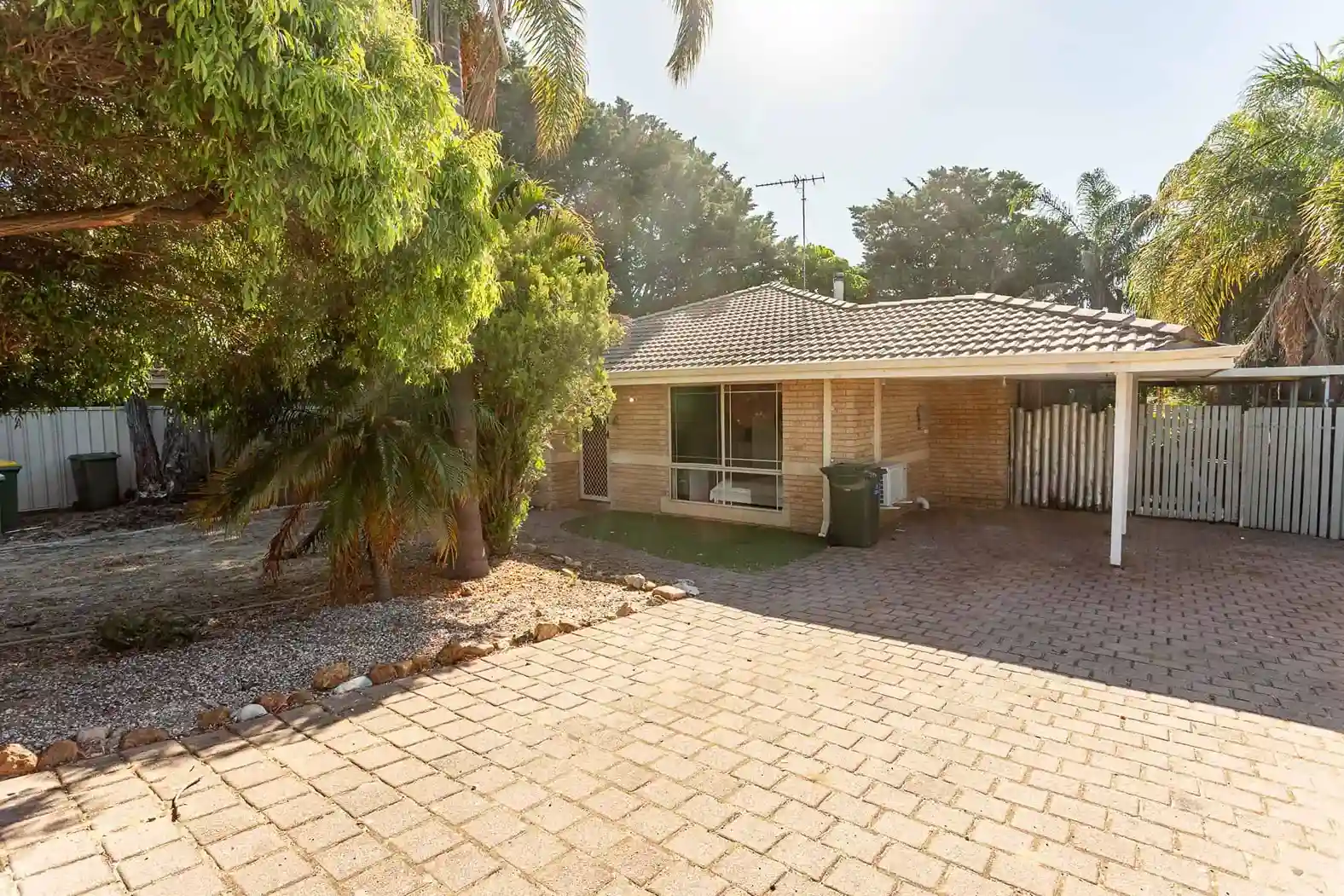
Perth can offer attractive co-living investment opportunities, but the postcode alone does not determine whether a property works.
We would assess:
- the relevant local government
- zoning and R-Code
- proposed resident numbers
- planning and building requirements
- parking
- room sizes and amenities
- access to employment and transport
- local rental demand
- likely conversion costs
- conventional resale potential
A strategy that works extremely well in one Perth council area may face different requirements only a short distance away.
What Makes a Good Co-Living Property Investment?
The purchase itself is one of the most important decisions in the entire co-living process.
At INVIDA, we are not simply searching for houses with as many bedrooms as possible.
There are several characteristics we would rather see.
1. A Floorplan That Converts Efficiently
The best conversion opportunities already have much of the required space in approximately the right places.
Bedrooms should be adequately sized and sensibly positioned. Existing plumbing should make additional bathrooms practical. The house should have enough overall space to provide comfortable private accommodation without sacrificing every communal area.
If converting the property requires moving structural walls, relocating major plumbing systems and reconstructing half the house, the conversion cost may quickly remove the financial advantage.
2. Strong Local Resident Demand
A co-living property needs residents, not merely bedrooms.
We look for locations where people have a practical reason to rent flexible, quality accommodation.
Potential demand generators can include:
- employment centres
- hospitals and health precincts
- universities
- major infrastructure projects
- public transport
- retail and services
- areas where conventional rental affordability is under pressure
The specific demand profile will vary by market.
High advertised room rents mean very little if the rooms remain vacant.
3. A Clear Regulatory Pathway
Planning needs to be assessed before purchase.
That includes understanding zoning, overlays, the intended land use, resident numbers, building requirements, fire safety, parking and any registration or licensing obligations that might apply.
This is particularly important for co-living because terminology changes across jurisdictions.
“Co-living housing”, “rooming accommodation”, “rooming house” and “lodging house” are not simply interchangeable marketing terms when you are dealing with planning and compliance.
4. Proper Communal Space
A common mistake is assuming that the best co-living design is simply the one containing the maximum possible number of bedrooms.
It isn’t.
Residents still need functional common facilities.
A property should provide an appropriate kitchen, laundry, circulation space and other shared areas suited to the intended resident profile.
A five-bedroom house that feels overcrowded can be a worse investment than a well-designed four-bedroom property that attracts better residents, commands better rents and achieves stronger retention.
5. Plumbing in the Right Places
Adding private or semi-private bathrooms can significantly improve the appeal of co-living accommodation.
But bathrooms are much more economical to create when bedrooms are close to existing wet areas and drainage.
A house that looks inexpensive at purchase can rapidly become expensive when every bedroom requires complicated plumbing modifications.
6. An Appropriate Parking and Access Solution
Parking requirements vary by jurisdiction, but practical resident expectations matter too.
A property occupied by five working professionals in a car-dependent suburb may experience problems if only one vehicle can reasonably be accommodated.
Tenant demographics should therefore be considered alongside the minimum regulatory requirement.
7. A Sensible Exit Strategy
Whenever possible, we prefer properties that retain mainstream residential appeal. Ask what happens if the investor eventually decides not to operate the property as co-living.
Could it still function as an attractive family home?
Could it become a conventional rental?
Would a future owner-occupier understand the floorplan?
A property that only makes sense to another specialist co-living investor may have a narrower resale market.
Compare Total Capital, Not Just Headline Yield

Another common mistake is comparing investment strategies using different calculations.
An investor might calculate the yield from a second dwelling against only its construction cost.
They then compare that figure with a co-living return based on the total cost of purchasing and converting the entire property.
That can make one strategy appear artificially stronger.
A better comparison starts with total capital deployed.
For each option, consider:
- purchase price
- stamp duty
- acquisition costs
- planning and professional fees
- construction or conversion costs
- finance and holding costs
- furniture
- compliance upgrades
- landscaping
- subdivision costs where applicable
- contingencies
Then calculate realistic income.
For a co-living property, that means considering not only potential room rents but also vacancy, property management, utilities, cleaning, maintenance, insurance and other operational costs.
The investment with the highest advertised gross yield is not necessarily the investment that produces the strongest return on your capital.
Which Strategy Fits Your Investment Goals?
Dual occupancy remains a legitimate strategy for investors whose primary objective is creating two residences, pursuing subdivision opportunities, manufacturing equity or retaining the option to sell properties separately where the relevant rules allow it.
Co-living is designed around a different objective.
For investors primarily seeking stronger recurring cash flow, it can create multiple income streams from one residential asset while spreading vacancy exposure across several residents.
That is why INVIDA generally favours co-living for investors focused on building an income-producing property portfolio.
- But we only favour it when the property is right.
- The house needs to work.
- The location needs to work.
- The regulatory pathway needs to work.
- The tenant market needs to work.
And most importantly, the numbers need to work after realistic costs have been included.
A property does not become a good co-living investment simply because another bedroom can fit inside it.
At INVIDA, our objective is to identify properties where the location, layout, compliance requirements, conversion costs and resident market support the strategy before significant capital is committed.
Thinking about investing in co-living? Speak with INVIDA before purchasing the property. We can help assess whether the location and property configuration suit the strategy and identify issues that could affect its conversion, compliance or income potential.