

7 Property and Economic Cycles to Check Before Buying
Let’s look at seven cycles and historical indicators that can influence property investment decisions.
1. The 18.6-Year Property Cycle: Understanding Market Expansion and Correction
This is the big one. Phillip J. Anderson’s research into historical property markets suggests that real estate cycles have followed recognisable patterns of expansion, temporary setbacks and correction.
One interesting feature is the mid-cycle dip.
These temporary downturns can occur during an otherwise expanding market and may be influenced by interest rates, credit restrictions or major economic events. For example, Australian property markets experienced weakness during 2018 and early 2019, particularly in Sydney and Melbourne.
At the time, there was considerable concern about where prices were heading.
However, the slowdown was followed by another period of growth, demonstrating that a dip doesn’t necessarily mean the beginning of an extended downturn. Historical events such as the Global Financial Crisis, international credit restrictions and changing United States monetary policy also demonstrate how financial conditions outside Australia can affect local property markets.
The important lesson is that markets respond to many different forces.
And while historical cycles can provide useful context, an investor should never assume that the next cycle will unfold exactly like the previous one.
What Should Investors Check Before Buying?
Before making an offer, investigate:
- Recent comparable property sales in the area.
- Whether prices have increased faster than local incomes or rents.
- Current rental vacancy conditions.
- The amount of competing housing available.
- Whether the property remains affordable if market growth slows.
A useful question to ask is whether you’d still be happy owning the investment if its value didn’t increase for several years.
If the answer is no, you may be relying too heavily on capital growth.
2. Historical Pandemic Cycles: Understanding Economic Recovery
 Looking at past pandemics can provide another perspective on economic and property market behaviour. The influenza pandemic of 1918–1919 was followed by significant economic and social changes, including the expansion commonly associated with the Roaring Twenties.
From approximately 1921 to 1929, parts of the global economy experienced strong growth, increased consumer spending and substantial investment activity.
It’s tempting to compare that period with the years following COVID-19. However, pandemics affect economies differently.
Government responses, employment conditions, supply chains, monetary policy and household finances all influence how markets recover. Australia experienced substantial changes in housing demand during and after COVID-19, including shifts in regional migration, working arrangements and preferences for living space.
These changes affected different housing markets in different ways.
One important lesson is that major disruptions can change what people need from their homes and where they choose to live. For property investors, understanding those changes can be more useful than trying to identify a repeating pandemic-related economic cycle.
What Should Investors Check Before Buying?
Consider the area’s employment base and the type of tenants likely to occupy the property. An area that depends heavily on one industry may be more vulnerable to economic disruption than a location with diverse employment opportunities.
It’s also worth investigating local population trends and whether demand for housing remains supported by employment, education, transport and essential services. The Australian Bureau of Statistics’ labour force data can help investors understand broader employment conditions.
For those considering rental properties, pay attention to whether the local tenant market is sufficiently diverse to support demand during changing economic circumstances.
3. Election Cycles: How Government Decisions Influence Property Markets
Have you noticed how buyers sometimes become cautious when an election approaches? Political uncertainty can influence consumer confidence and purchasing decisions.
Some buyers prefer to wait until election results are known, particularly when housing policies, taxation arrangements or investment incentives are under discussion. This can sometimes lead to slower activity in certain property markets.
Historically, investors have looked at these periods as possible opportunities to negotiate. However, elections don’t automatically create favourable buying conditions. The effect depends on the policies being proposed, the existing economic environment and whether those policies are eventually implemented.
For example, changes to negative gearing, land tax, stamp duty concessions, housing supply initiatives or residential tenancy regulations may influence investment decisions. But these changes need to be assessed individually.
A property that looks attractive before an election may become less appealing if new regulations increase operating costs or limit its intended use. Equally, new infrastructure investment or housing initiatives could strengthen demand in particular areas.
What Should Investors Check Before Buying?
Keep an eye on government policies that could affect:
- Property acquisition costs and taxes.
- Residential tenancy requirements.
- Housing supply and development.
- Local infrastructure investment.
- Building and planning regulations.
- Investment-related concessions and incentives.
If you’re investing in Queensland, the Queensland Government’s property buying and ownership information provides a useful starting point. Ultimately, a good investment should be assessed on its fundamentals rather than the assumption that an election will create a short-term bargain.
4. Inflation and Interest Rate Cycles: Why Your Borrowing Costs Matter
Inflation is one of the most important economic indicators property investors should watch.
When inflation increases, the costs of goods and services generally rise. For property owners, this can mean higher maintenance expenses, building materials, insurance premiums, management costs and other ongoing expenses.
Inflation also influences interest-rate decisions.
The Reserve Bank of Australia considers inflation, employment and broader economic conditions when setting monetary policy. Changes in interest rates can have a significant impact on investors who borrow to purchase property.
When interest rates rise, mortgage repayments may increase, particularly for borrowers with variable-rate loans. That means a property which appeared affordable at one interest rate might become considerably more expensive to hold at another.
The Reserve Bank of Australia’s cash rate information provides a current reference for monetary policy, while the ABS Consumer Price Index tracks changes in consumer prices. Both are worth reviewing when assessing a potential investment.
However, the RBA’s cash rate isn’t the same as the mortgage rate your lender charges, and individual lenders can adjust their rates independently.
How Do Interest Rates Relate to the 18.6-Year Property Cycle?
Credit availability and borrowing costs can influence property market expansion and contraction. When finance is affordable and readily available, buyers may have greater capacity to enter the market.
When borrowing becomes more expensive or lending requirements tighten, property demand may weaken. These changes can contribute to broader property market cycles. However, interest rates don’t follow a predetermined 18.6-year schedule.
Their direction depends on contemporary economic conditions. That’s why your borrowing calculations should reflect current loan offers and realistic future scenarios rather than historical predictions.
What Should Investors Check Before Buying?
Before purchasing, calculate what happens to your repayments if interest rates increase.
Ask yourself:
- Can I comfortably afford the loan repayments?
- What happens if rental income temporarily decreases?
- Have I allowed for maintenance, insurance and management expenses?
- Do I have sufficient financial reserves for unexpected costs?
- Can I continue holding the property during a prolonged period of higher borrowing costs?
These questions matter regardless of where Australia sits in a historical property cycle.
5. Long-Term Housing Market Cycles: Learning From 140 Years of History
Australia’s housing market has experienced an extraordinary range of economic conditions over the past 140 years. Major events such as World War I, World War II, the Great Depression, credit expansions, mining booms and financial crises have all influenced property markets.
Looking at these events over a longer timeframe helps put short-term market movements into perspective. A few years of weaker growth may seem significant when you’re watching property prices every month.
However, investors planning to hold property for 20 or 30 years generally need to consider much broader economic and demographic trends. That doesn’t mean long-term ownership guarantees a good outcome.
Some properties experience prolonged periods of limited growth, and particular locations can be negatively affected by changing employment patterns, oversupply or economic decline. Individual properties can also lose substantial value.
The lesson is to understand the difference between a temporary market slowdown and a more fundamental change affecting the property’s long-term desirability.
Look at Local Market Drivers
Before purchasing, investigate what’s supporting demand in the area. Population growth is one consideration.
Areas attracting new residents may experience increased demand for housing, particularly when new supply is limited. Employment opportunities and infrastructure can also contribute to demand.
But population growth alone doesn’t guarantee stronger property prices or rental returns. The amount of available housing matters too.
The ABS population statistics and building approvals data provide useful background information about population movements and future construction activity.
These figures should be supported by local research before making a purchase decision.
What Should Investors Check Before Buying?
Investigate the location’s:
- Population and household growth.
- Employment opportunities.
- Access to transport, education and services.
- Existing and planned housing supply.
- Local rental demand.
- Recent comparable property sales.
Also consider how long you intend to hold the investment.
If you’re planning to sell within a few years, short-term market fluctuations may have a much greater effect on your financial outcome.
6. Compound Property Growth: Understanding Long-Term Returns
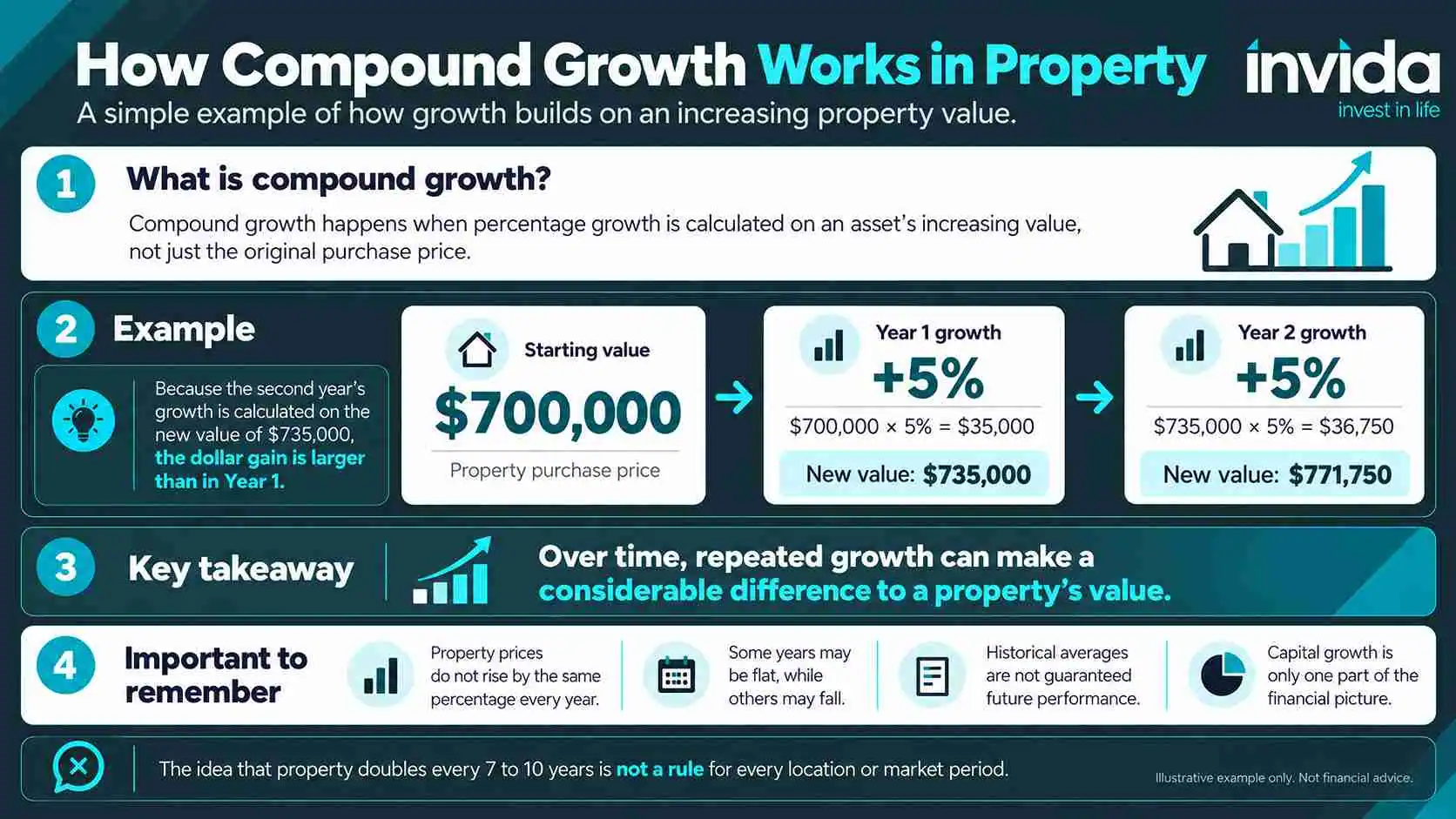
Compound growth is one of the reasons property appeals to long-term investors. Put simply, compounding occurs when percentage growth is calculated on an asset’s increasing value.
For example, imagine a property purchased for $700,000. If its value increased by 5% over one year, the increase would be $35,000.
If the property then increased by another 5% the following year, that increase would be calculated on its new value of $735,000.
Over an extended period, repeated growth can produce a considerable difference in value.
However, there’s an important catch. Property prices don’t increase by the same percentage every year. Some years may deliver strong growth, while others may experience stagnation or falling values.
Historical Australian property data has demonstrated the potential for compound growth over long periods, but those historical averages shouldn’t be confused with guaranteed future performance.
The frequently repeated idea that property doubles in value every seven to ten years is not a rule that applies to every location or market period.
And capital growth is only one part of the financial picture.
Why Capital Growth Isn’t the Whole Story
A property might increase in value over time while still requiring substantial ongoing contributions from its owner. Mortgage interest, maintenance, insurance, management fees, council rates and other expenses can significantly affect overall returns.
It’s also important to account for acquisition and selling costs.
The Australian Government’s Moneysmart guidance on property investment explains the costs and financial risks associated with investment properties. At INVIDA, we encourage investors to consider rental income alongside potential capital growth.
A property that produces stronger income may provide greater financial flexibility, although its suitability depends on acquisition costs, financing, occupancy and ongoing expenses.
For a deeper explanation of these calculations, our guide to return on investment property explores how income and costs influence investment performance.
What Should Investors Check Before Buying?
Consider what happens if your property experiences little or no capital growth for five years.
Would the rental income be sufficient to help support the ongoing expenses?
Can you manage the difference between income and costs?
Do you have the financial capacity to maintain the property throughout periods of weaker market performance?
These questions are often more useful than assuming future price increases will solve every financial challenge.
7. The Skyscraper Index: What Major Construction Projects Can Tell Us
The Skyscraper Index is one of the more unusual economic theories connected with property market cycles.
Introduced by economist Andrew Lawrence, the theory suggests that the construction of exceptionally tall buildings has sometimes coincided with periods of economic expansion followed by financial downturns.
The reasoning is that large, ambitious developments may reflect high levels of business confidence and relatively easy access to finance. During an economic boom, developers and financiers may be willing to commit substantial amounts of money to major projects.
However, by the time construction is completed, economic conditions may have changed. Historically, some major skyscraper projects have coincided with periods of financial instability. But this doesn’t mean the completion of a tall building causes an economic downturn. Nor does it mean skyscraper construction reliably predicts a crash.
The theory is better treated as a historical observation about construction activity, investment confidence and credit conditions.
Why Should Residential Property Investors Pay Attention?
For residential property investors, the more practical consideration is housing supply. Major construction activity can indicate confidence and economic investment in a location. However, a substantial pipeline of new apartments or residential developments can also increase competition for tenants.
If housing supply grows faster than demand, landlords may face greater pressure on rental prices or longer vacancy periods. On the other hand, construction associated with expanding employment and population may support local housing demand.
That’s why context matters.
A construction boom isn’t automatically a warning sign, just as limited development isn’t always an advantage.
What Should Investors Check Before Buying?
Research planned housing developments and how many new properties may become available over the coming years. Local planning information and the ABS building approvals statistics can provide insight into proposed supply.
Also examine rental vacancies and comparable properties currently advertised for rent. The question isn’t simply whether construction is increasing. It’s whether the local market has sufficient demand to support the housing being delivered.
How to Use the 18.6-Year Property Cycle Before Buying an Investment Property

Understanding the 18.6-year property cycle can provide useful perspective, but it shouldn’t become the deciding factor in your next purchase. A property can be located in a market that appears favourable according to a historical cycle and still be an unsuitable investment.
Similarly, slower market conditions don’t automatically mean every available property is a poor opportunity. The key is to combine broader economic research with detailed due diligence on the individual property.
Check the Local Market Before Following National Predictions
National property headlines rarely tell the whole story. Even within the same city, neighbouring suburbs can experience different levels of demand, price growth and rental activity.
Before buying, investigate the property’s immediate location. Look at recent sales of comparable homes, the number of properties available to rent and the types of tenants the area attracts.
This provides a clearer picture of the market you’re entering.
Understand the Financial Risks
Every investment comes with risks. The important thing is understanding which risks you’re comfortable managing and how they could affect your financial position.
At INVIDA, we encourage investors to examine borrowing costs, holding expenses, vacancy assumptions and project requirements before committing.
Our guide to property investment risk profiles examines how investors can approach risk in greater detail.
For this particular purchase, focus on the risks associated with the actual property rather than assuming a favourable market cycle will protect you.
Consider Your Investment Timeframe
Your intended holding period matters. An investor planning to sell within three years may approach market conditions differently from someone intending to hold a property for several decades.
If you’re working towards multiple property investments, our article about building a property portfolio explores broader acquisition strategies.
However, before expanding a portfolio, make sure each prospective purchase is financially suitable on its own.
Can a High-Yield Property Strategy Help You Manage Market Cycles?
One of the challenges with traditional property investing is relying too heavily on capital growth. When prices are increasing, it’s easy to concentrate on what a property might be worth in five or ten years.
But what happens when growth slows?
This is where rental income becomes an important consideration. At INVIDA, we help investors assess opportunities to increase rental income through suitable co-living property conversions.
Depending on the property, its location and the relevant approval requirements, an existing home may be reconfigured to accommodate multiple residents. Rather than receiving rent from one household occupying the entire dwelling, a suitable co-living arrangement may provide income from several individually rented rooms.
That creates the potential for higher gross rental income. However, higher rent doesn’t automatically mean higher profits.
Conversion costs, ongoing maintenance, utilities, vacancy periods, management expenses and financing arrangements all influence the financial outcome.
Why Cash Flow Matters When Property Markets Slow
A property that generates sufficient rental income to support its ongoing expenses may be easier to hold during periods of slower capital growth.
That’s particularly important when borrowing costs remain elevated or unexpected expenses arise. But investors should be careful not to assume that multiple rental income streams eliminate risk.
A co-living property may involve more complex management arrangements and higher operating expenses than a conventional rental. Individual room vacancies, tenant turnover and maintenance requirements also need to be considered.
The objective should be to establish realistic income expectations and understand the costs involved.
Check Co-Living Suitability Before You Buy

Not every property is suitable for co-living.
Before purchasing a home with the intention of converting it, investigate the property’s layout, zoning, building requirements, parking, location and potential tenant demand.
Depending on the proposal, planning approval, building approval and additional safety requirements may apply.
These requirements can vary between states, councils and accommodation types.
It’s also important to understand the total cost of converting the property and whether the projected rental income supports that investment.
INVIDA’s guide to how co-living property conversions work explains the assessment, design, approval and construction considerations involved.
The goal isn’t to beat the property cycle. It’s to make an informed investment decision that doesn’t depend entirely on predicting future price growth.
Your 7-Point Property Cycle Checklist Before Buying
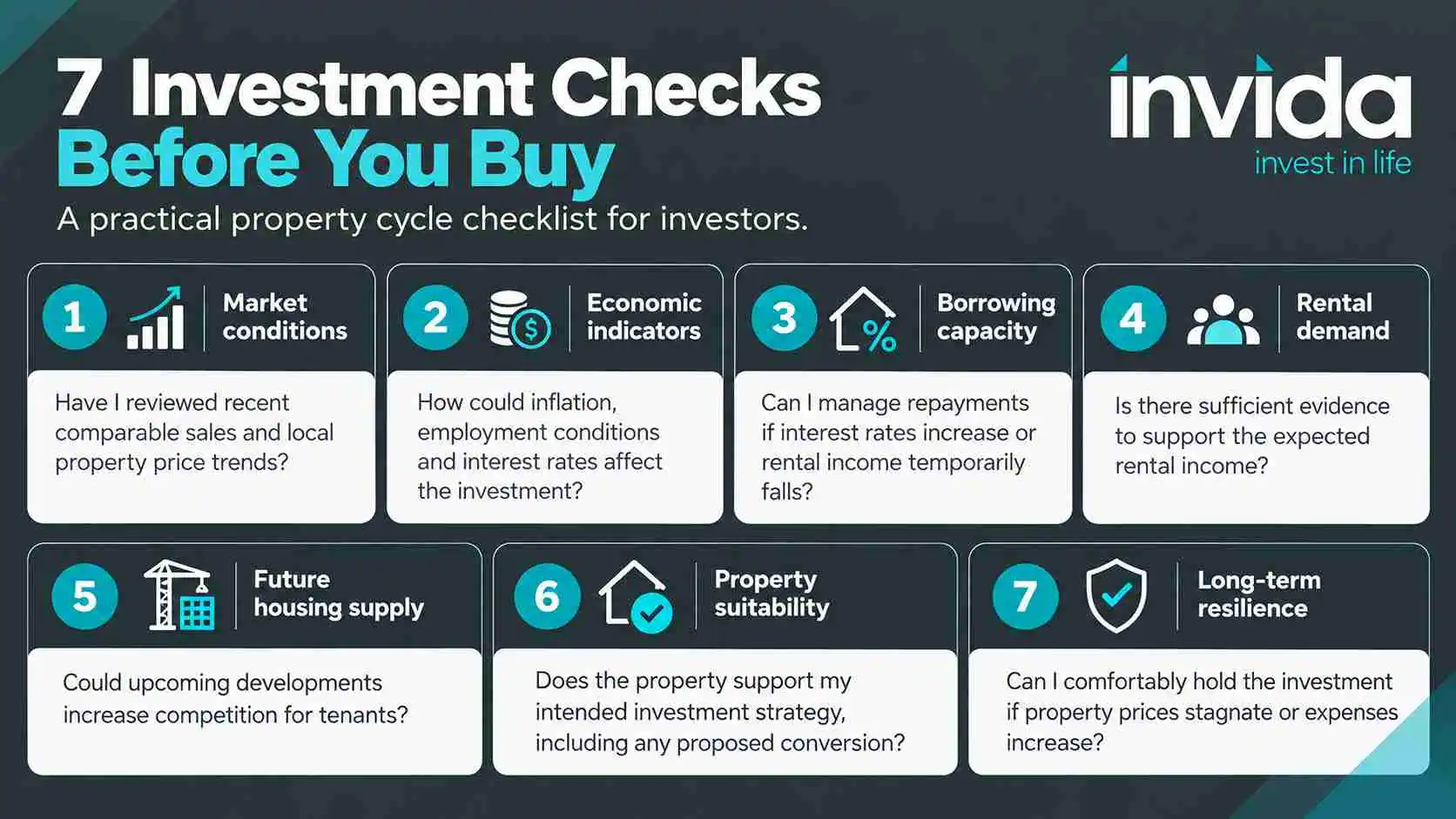
Before committing to your next investment, work through these seven checks.
| Investment Check | What to Investigate |
| 1. Market Conditions | Have I reviewed recent comparable sales and local property price trends? |
| 2. Economic indicators | How could inflation, employment conditions and interest rates affect the investment? |
| 3. Borrowing capacity | Can I manage repayments if interest rates increase or rental income temporarily falls? |
| 4. Rental demand | Is there sufficient evidence to support the expected rental income? |
| 5. Future housing supply | Could upcoming developments increase competition for tenants? |
| 6. Property suitability | Does the property support my intended investment strategy, including any proposed conversion? |
| 7. Long-term resilience | Can I comfortably hold the investment if property prices stagnate or expenses increase? |
If you can’t confidently answer several of these questions, you may need to do more research before proceeding.
A property can look attractive on paper but still be unsuitable for your circumstances.
The more clearly you understand the costs, limitations and local market conditions, the better equipped you’ll be to make a decision.
Other Property Market Indicators Worth Watching
The seven cycles we’ve discussed provide a useful foundation for property market research.
However, several additional indicators can help investors understand what’s happening in the broader economy.
These include:
- Consumer sentiment: Changes in household confidence can affect purchasing and spending decisions.
- National dwelling approvals: Building approvals provide insight into potential future housing construction, although not every approved development proceeds.
- Interstate migration: Population movements can influence housing demand in particular states and regions.
- Household debt: High debt levels can increase financial vulnerability when borrowing costs rise.
- Home loan arrears: Rising mortgage repayment difficulties can indicate pressure on borrowers.
The RBA Financial Stability Review provides information about household financial conditions and risks within Australia’s financial system.
Meanwhile, ABS regional population data can help investors examine population changes across different locations.
Again, no single indicator provides a complete picture.
The most useful approach is to examine several reliable sources and consider how they relate to your intended investment.
3 Things to Be Careful About When Researching Property Cycles
There’s plenty of information available about property markets. But not all of it deserves the same level of attention.
Here are three things worth keeping in perspective.
1. Short-Term Seasonal Fluctuations
Property markets and economic indicators can experience seasonal changes.
For example, consumer spending may slow after Christmas, while construction approvals and property transactions can fluctuate around holiday periods.
These changes don’t necessarily indicate a major market downturn.
Before drawing conclusions, compare current figures with longer-term trends and, where appropriate, seasonally adjusted data.
2. Sensational Property Headlines
Property headlines are often designed to attract attention.
One week, you might read about an approaching crash. The next, you might see predictions of another extraordinary boom.
The truth is generally more complicated.
A temporary slowdown doesn’t automatically mean the market is collapsing, just as a few months of strong growth don’t guarantee future increases.
Look beyond the headline and investigate the evidence.
3. Treating Economic Forecasts as Certainties
Even experienced economists can get property market predictions wrong.
Forecasts depend on assumptions about interest rates, employment, inflation, borrowing and many other variables.
When those assumptions change, the forecast may no longer hold.
That’s why it’s worth comparing several sources rather than relying on one prediction.
The same principle applies to historical property cycles.
Use them to inform your research, not to replace it.
Make Your Next Property Investment Decision With More Confidence
Understanding the 18.6-year property cycle can give you a broader perspective on how property markets behave.
But the most important part of investing isn’t predicting exactly what the market will do next.
It’s choosing a property that makes financial sense, suits your investment goals and can be managed through different economic conditions.
Before buying, take the time to understand the local market, borrowing costs, rental demand and any development requirements associated with your intended strategy.
If you’re considering co-living as a way to potentially increase rental income, it’s worth establishing whether your prospective property is suitable before committing to a purchase.
At INVIDA, we help investors explore opportunities to create higher-yield properties through carefully planned co-living conversions.
From assessing property suitability to understanding the design, approval and construction considerations, our team can help you explore what’s involved.
Thinking about your next investment property?
Discover how INVIDA can help you assess a property’s co-living potential and take the next step towards a more informed investment decision.