What Makes a High Yield Investment Property?
A high yield investment property generates relatively strong rental income compared with the amount invested in it. However, a high advertised yield does not automatically mean a property is profitable.
Investors need to understand the difference between gross and net rental yield before comparing opportunities.
Gross Rental Yield vs Net Rental Yield
Gross rental yield measures annual rental income against the property’s value or purchase price, before expenses.
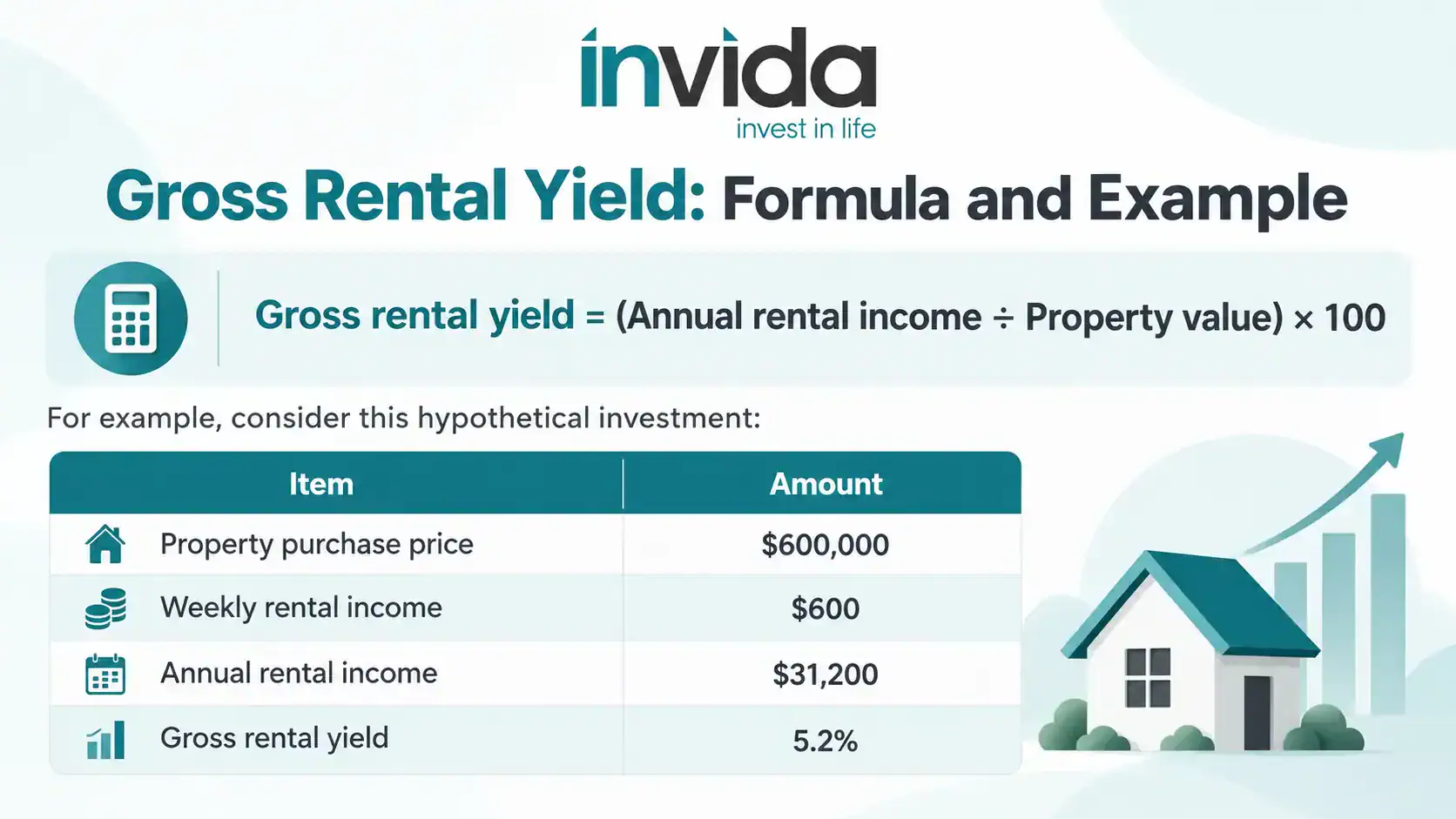
A 5.2% gross yield might appear attractive, but it doesn’t account for ongoing expenses.
Net rental yield provides a more realistic picture by deducting property operating costs such as management fees, maintenance, insurance and rates.
Net rental yield = (Annual rental income − Annual operating expenses) ÷ Total property investment cost × 100
If the hypothetical property above has $7,200 in annual operating expenses, its net yield would be 4%, assuming a $600,000 investment cost.
This calculation excludes loan interest, principal repayments and tax. Investors should assess those separately when calculating cash flow and their overall return.
Rental Yield vs Capital Growth: Finding the Balance
High-yielding property investments often prioritise rental income, while capital-growth strategies focus on the property’s potential to increase in value over time.
Neither approach is automatically better.
A property generating substantial rent may experience slower capital growth, while a property in a desirable growth market might deliver lower rental income relative to its purchase price.
The challenge is finding an investment that supports your financial objectives without exposing you to unnecessary risk.
Why Rental Yield Matters More After the 2026 Tax Changes
Australia’s 2026 tax reforms have made rental income and cash flow even more important considerations for property investors.
Under the Treasury Laws Amendment (Tax Reform No. 1) Act 2026, from 1 July 2027, investors who acquired established residential properties after 7:30 pm AEST on 12 May 2026 generally cannot offset net rental losses against unrelated income, such as wages. Instead, eligible losses can be offset against residential property income or carried forward, subject to the applicable rules.
Properties acquired before the announcement are exempt from the new negative gearing restrictions, while qualifying new residential dwellings retain their existing negative gearing treatment.
The reforms also change capital gains tax arrangements from 1 July 2027, replacing the existing 50% CGT discount with an inflation-based approach and introducing a 30% minimum tax rate on relevant gains. Qualifying new residential dwellings retain an option to use the existing 50% discount.
For investors, these changes reinforce the importance of evaluating a property’s actual income, expenses and long-term financial performance rather than relying primarily on tax deductions.
*Disclaimer: This information is provided for general educational and informational purposes only and does not constitute financial, investment, tax or legal advice. It does not take into account your individual circumstances, financial situation or investment objectives. Before making any property investment or tax-related decisions, you should seek independent advice from a suitably qualified and licensed professional who can assess your personal circumstances and needs.
7 Alternative Strategies for a High Yield Investment Property

There is no single formula for generating strong rental returns. Different strategies use property design, location, income arrangements or purchasing decisions to improve performance.
Here are seven approaches worth comparing.
1. Co-Living Conversions
One way to create a high yield investment property is to change how an existing home generates rental income.
Rather than leasing the entire property to one household, a co-living conversion creates several private accommodation spaces within the same home.
Each resident rents an individual room, often featuring a private ensuite and kitchenette, while sharing selected communal facilities.
What drives the yield?
The primary advantage is the potential to generate several rental incomes from one property.
INVIDA’s co-living model typically creates three to five income streams under one roof. INVIDA also describes gross returns ranging from 7% to 11% for its broader investment model, although actual results vary depending on the property, location and project costs.
Instead of losing all rental income when a single household moves out, a co-living property may continue earning income from its remaining occupied rooms.
What should investors watch out for?
Not every house is suitable for conversion. Property layout, council requirements, fire safety, construction costs and local rental demand can determine whether the project is commercially viable.
Multiple residents also mean more intensive management, maintenance and operational responsibilities.
Who does it suit?
Co-living conversions may suit investors who already own a suitable property or want to purchase an established home with the potential to increase rental income.
Learn more about how INVIDA’s co-living model works and the considerations when choosing a new build or conversion.
2. Custom-Built Co-Living Homes and House-and-Land Packages
Instead of modifying an existing property, investors can build a home specifically designed to accommodate multiple residents.
Purpose-built co-living properties incorporate private living spaces, bathrooms and shared facilities into the original design.
This can be achieved through a new house-and-land package or a knock-down-rebuild strategy, where an existing dwelling is demolished and replaced with a purpose-built co-living home.
A knock-down-rebuild may be worth considering when an existing house has an unsuitable layout, significant structural problems or conversion costs that make renovation commercially unviable.
Both approaches allow investors to consider privacy, sound insulation, maintenance requirements and efficient use of space before construction begins.
What drives the yield?
A purpose-built layout can improve the number and quality of rentable spaces without relying on expensive retrofitting.
For a knock-down-rebuild project, replacing an unsuitable dwelling may also create an opportunity to make better use of the existing land and design the property around multiple rental income streams.
Thoughtful design may improve resident satisfaction, helping support occupancy and reduce unnecessary turnover.
What should investors watch out for?
Land acquisition, demolition and site preparation costs, construction expenses, financing, planning approvals and potential building delays can significantly influence the final investment cost.
For knock-down-rebuild projects, investors should also investigate demolition restrictions, existing services, site conditions and whether the proposed co-living development can obtain the necessary approvals.
Investors should assess whether the expected rental income justifies the additional capital required, particularly when comparing a knock-down-rebuild with converting an existing property.
Who does it suit?
This strategy may appeal to investors who prefer a new property designed around their intended rental model and have the borrowing capacity to fund construction.
A knock-down-rebuild may be particularly suitable for investors who already own a property in a location with strong co-living rental demand but whose existing dwelling is unsuitable or too costly to convert.
Explore INVIDA’s custom-built co-living homes and co-living house and land packages.
3. Compliant Rooming Accommodation
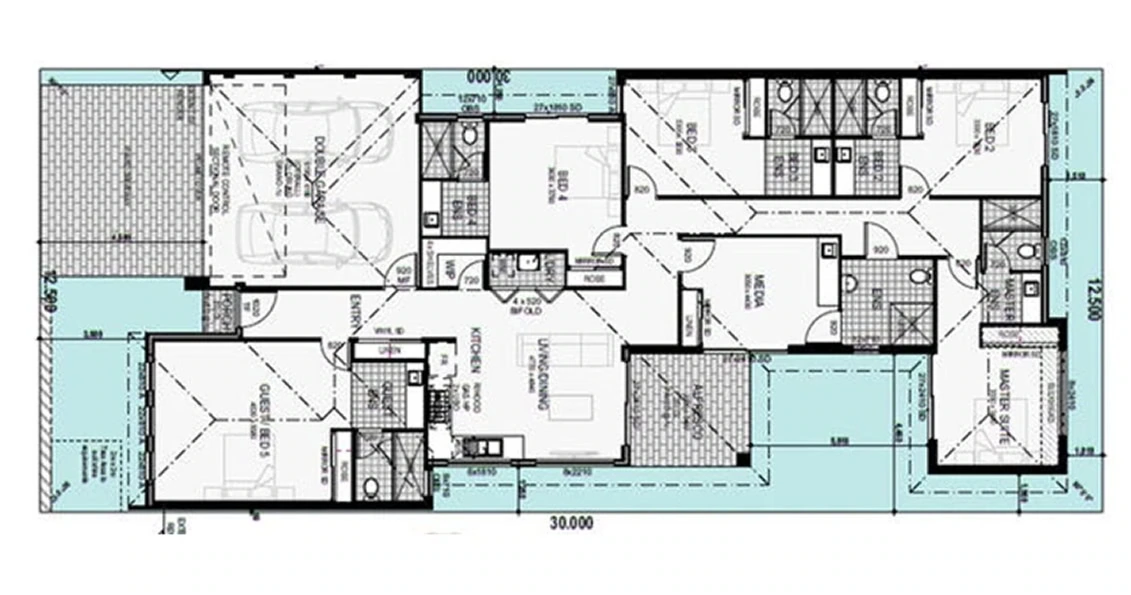
Some investors pursue higher rental income by purchasing or developing properties intended for rooming accommodation.
While the income structure may resemble co-living, the property’s legal classification and approval requirements determine how it can operate.
Depending on the building’s characteristics and applicable regulations, accommodation may fall under classifications such as Class 1b or Class 3 of the National Construction Code.
What drives the yield?
Room-by-room accommodation can generate multiple income streams from a single building, potentially improving gross rental yield.
However, the number of rentable rooms is only one factor. Compliance expenses and operational costs also affect profitability.
What should investors watch out for?
Building classification, council approvals, fire safety, insurance and financing arrangements can all influence the property’s commercial viability.
A property that appears attractive based on rental income alone may require substantial expenditure to meet the applicable standards.
Its approved use and configuration may also affect future resale options.
Who does it suit?
This alternative property investment approach may suit investors prepared to undertake detailed due diligence and work with qualified building, planning and finance professionals.
Before purchasing, review what to check before buying a co-living property.
4. Dual Occupancy
Dual occupancy is another way investors may generate additional rental income from a single property holding.
The strategy generally involves two dwellings on one allotment, subject to the applicable planning requirements. Depending on the arrangement, each dwelling may be leased separately.
What drives the yield?
Two rental incomes can provide a stronger combined return than a single dwelling, particularly when the second residence makes efficient use of the available land.
Separate accommodation may also appeal to different household types, potentially broadening rental demand.
What should investors watch out for?
Council regulations, minimum lot requirements, infrastructure charges, construction expenses and approval pathways vary between locations.
Investors should also establish whether the proposed arrangement can be legally approved before purchasing or committing to development.
Higher total rent does not necessarily mean a better net return if construction and holding costs are substantial.
Who does it suit?
This approach may suit investors with suitable land, sufficient development capital and a preference for operating two distinct residential dwellings.
5. Rentvesting
Rentvesting involves renting a home in the location where you prefer to live while purchasing an investment property elsewhere.
It allows investors to separate their lifestyle preferences from their investment decisions.
For example, someone who prefers to live close to a major employment centre may choose to rent locally while buying in a market where property prices and rental returns better suit their budget.
What drives the yield?
Rentvesting gives investors greater flexibility to select properties based on financial performance rather than personal living requirements.
This can open opportunities in locations that may offer a more favourable relationship between purchase price and rental income.
What should investors watch out for?
Rentvestors must account for both their own housing expenses and the costs associated with owning an investment property.
Vacancies, loan repayments, maintenance and changes in rental demand can place pressure on household cash flow.
Tax treatment should also be considered when comparing established and newly constructed investment properties.
Who does it suit?
Rentvesting may appeal to first-time investors and people who want to enter the property market without changing where they currently live.
Discover how a rentvesting strategy can work alongside co-living investment.
6. Positive Cash Flow Property

A positive cash flow property generates enough rental income to cover its ongoing expenses, including relevant financing costs.
Rather than depending primarily on future price appreciation, this strategy focuses on the property’s ability to support itself financially.
For investors considering a high yield investment property, this distinction is particularly important because gross yield and actual cash flow are not interchangeable.
What drives the yield?
Positive cash flow may be achieved through careful purchasing, appropriate financing, efficient property management or an accommodation model capable of generating additional rent.
The objective is to ensure the income remains sufficient after realistic costs and vacancy allowances are considered.
What should investors watch out for?
An attractive gross yield can still result in negative cash flow when interest, maintenance, insurance and other expenses are included.
Investors should test their projections against higher costs, unexpected repairs and periods of reduced occupancy.
Who does it suit?
This approach may appeal to investors who prioritise income stability, reducing out-of-pocket holding costs or building a portfolio that is less dependent on ongoing personal contributions.
Read more about positively geared co-living investments and INVIDA’s case study on moving from negatively geared to positive cash flow.
Negative Gearing vs Positive Gearing
Understanding negative gearing vs positive gearing helps investors distinguish between tax outcomes and property cash flow.
A negatively geared property generally has deductible expenses exceeding assessable rental income, while a positively geared property generates more assessable rental income than its deductible expenses.
However, positive gearing for tax purposes and positive cash flow after all loan repayments are not necessarily the same.
The tax treatment of rental losses can influence the after-tax cost of holding an investment. Investors should confirm the legislation applying to their purchase and ownership circumstances with a qualified tax adviser.
7. Targeting High Rental Yield Suburbs and Regional Markets
Another approach involves identifying locations where rental income is relatively strong compared with property purchase prices.
Some regional markets and lower-priced metropolitan areas may offer attractive gross rental yields, but headline figures should never be the only reason to invest.
What drives the yield?
Lower acquisition costs relative to achievable rents can improve gross returns, particularly in markets with established employment opportunities and sustained rental demand.
What should investors watch out for?
A high yield may reflect weaker capital growth prospects, limited buyer demand, economic concentration or greater vacancy risk.
Investors should investigate employment diversity, population trends, local infrastructure, housing supply and resale demand before committing.
Who does it suit?
This approach may suit investors comfortable researching unfamiliar markets and balancing rental income against long-term growth and liquidity.
Explore INVIDA’s guides to high rental yield suburbs, including opportunities in Brisbane and Victoria.
Comparing the 7 Strategies at a Glance
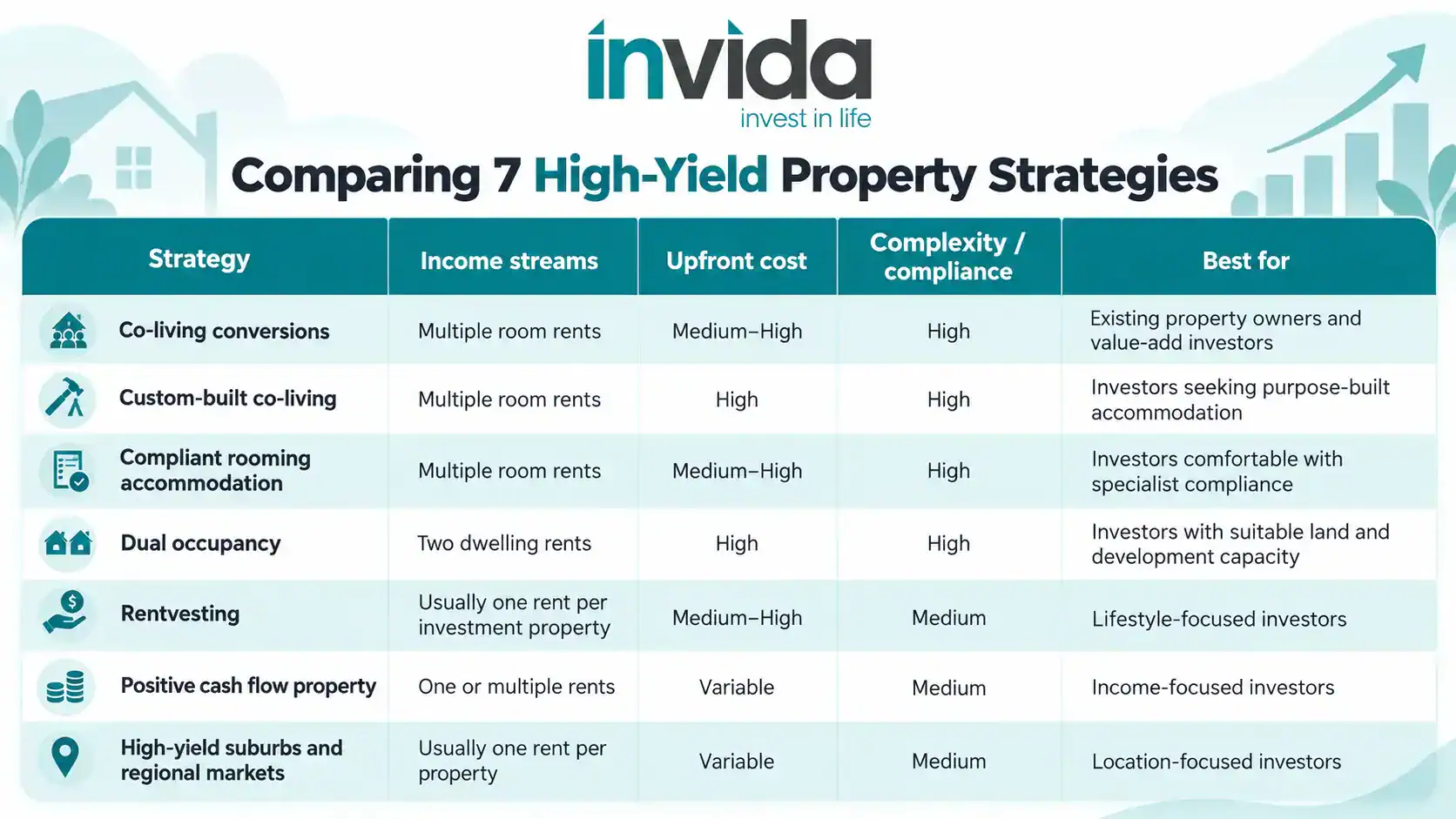
The table below provides a general comparison of the seven approaches. Actual costs and complexity depend on the individual property, its location and the scope of work involved.
| Strategy | Income Streams | Upfront Cost | Complexity /Compliance | Best For |
| Co-Living Conversions | Multiple Room Rents | Medium-High | High | Existing property owners and value-add investors |
| Custom-built co-living | Multiple room rents | High | High | Investors seeking purpose-built accommodation |
| Compliant rooming accommodation | Multiple room rents | Medium-High | High | Investors comfortable with specialist compliance |
| Dual occupancy | Two dwelling rents | High | High | Investors with suitable land and development capacity |
| Rentvesting | Usually one rent per investment property | Medium-High | Medium | Lifestyle-focused investors |
| Positive cash flow property | One or multiple rents | Variable | Medium | Income-focused investors |
| High-yield suburbs and regional markets | Usually one rent per property | Variable | Medium | Location-focused investors |
These are qualitative comparisons, not forecasts. The upfront cost ratings are indicative and can change significantly between projects.
How to Choose the Right High Yield Strategy
Finding the right high yield investment property involves more than selecting whichever strategy advertises the highest potential return.
The better approach is to evaluate how each investment fits your finances, objectives and ability to manage risk.
Define Your Investment Goals
Are you primarily looking for additional monthly income, long-term capital growth or a combination of both?
Investors seeking immediate cash flow may prioritise different properties from those planning to hold an asset for decades.
Understand Your Budget and Borrowing Capacity
Consider the total cash required, including purchasing expenses, renovation or construction costs, financing and an allowance for unexpected expenditure.
For specialist accommodation, confirm lending requirements early, as lenders may assess non-standard rental arrangements differently.
Consider Your Time and Management Requirements
A conventional rental property may require less day-to-day involvement than a home with several independently leased rooms.
Professional management can reduce your workload, but management fees and service arrangements must be included in financial projections.
Evaluate Risk Beyond the Advertised Yield
A strong rental yield cannot compensate for every investment risk.
Consider vacancy rates, local economic conditions, property conditions, regulatory requirements and the possibility of higher operating expenses.
It is also worth assessing how easily the property could be sold or adapted if your circumstances change.
For a broader understanding of the costs and considerations involved, read INVIDA’s guide to return on investment property.
Before proceeding, seek independent financial, tax and legal advice to ensure the proposed investment is appropriate for your circumstances.
Finding a High Yield Investment Property That Suits Your Goals with INVIDA
A high yield investment property isn’t necessarily the one with the most impressive advertised rental return. It’s the one that generates sustainable income while remaining financially viable, appropriately managed and suited to your long-term objectives.
Whether you’re considering rentvesting, purchasing in a high-yield market or developing a property with multiple rental incomes, understanding the trade-offs is essential.
Co-living is one option worth exploring, particularly for investors interested in generating additional rental income from a single residential property.
At INVIDA, we help investors assess suitable properties, understand co-living opportunities and explore conversion or purpose-built options.
Want to explore whether co-living could work for your investment goals?
Book a strategy call with INVIDA to discuss your options and the next steps.