
Understanding Your Investment Risk Profile
Understanding your investment risk profile is important. It helps you choose a property investment strategy that suits your financial position, goals and comfort with uncertainty. Without a clear understanding of how much risk you can realistically manage, it can be easy to take on too much debt, underestimate holding costs or choose a strategy that creates unnecessary financial pressure.
By assessing both your willingness to accept risk and your ability to absorb setbacks, you can make more informed decisions and focus on opportunities that are better aligned with your long-term plans.
My Own Property Investment Risk Profile and How It Changed
I was a classic high-risk serial entrepreneur in my 20s and 30s. I started multiple businesses in the belief that, if I tried enough times, one would eventually succeed. None of my first 15 businesses worked, but I would simply move on to the next quick, shiny opportunity.
Ironically, I have experienced anxiety since my teenage years, so that high-risk period of my life was confronting. Looking back, I could have saved myself a great deal of stress, and probably made better financial decisions, if I had matched my investing behaviour more closely to my actual appetite for risk.
My financial results improved when I began making more structured decisions. I surrounded myself with mentors who had already made mistakes I could learn from, researched opportunities more carefully and stopped relying on optimism alone. In effect, I became a medium-risk investor with better systems and support around me.
That is an important point: your natural risk profile may influence your decisions, but it does not have to control them. The right advice, research and safeguards can help you make more balanced choices.
How Risky Are You? Take the Freeway Test
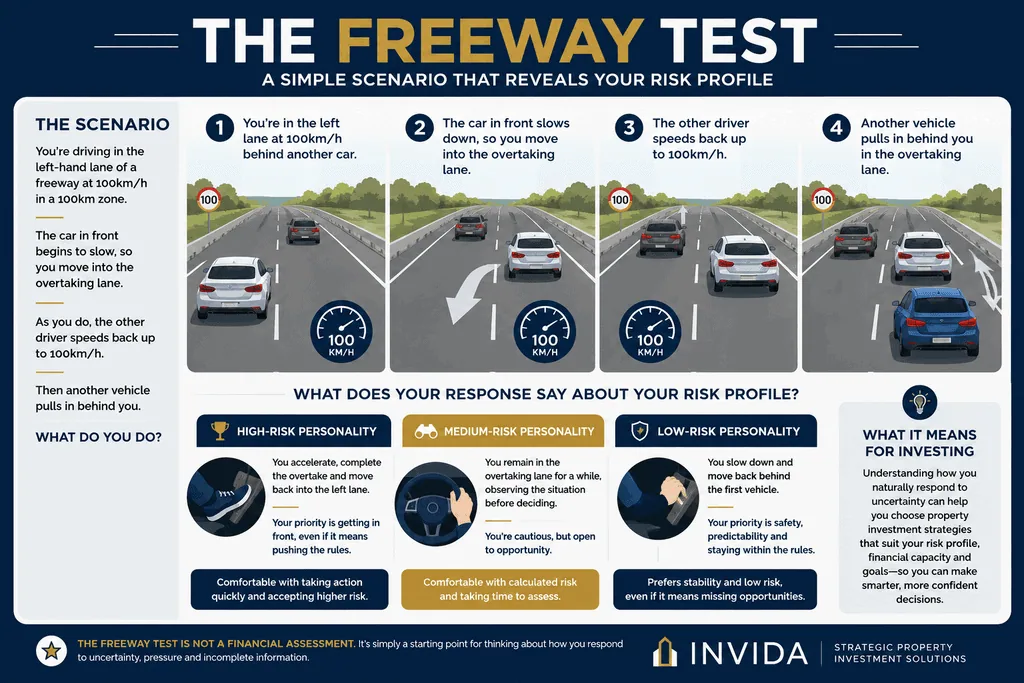
Here is a simple scenario I use when helping people think about their attitude towards risk.
Imagine you are driving in the left-hand lane of a freeway at 100 kilometres per hour in a 100-kilometre zone. The car in front begins to slow, so you move into the overtaking lane. As you do, the other driver speeds back up to 100 kilometres per hour. Then another vehicle pulls in behind you.
What do you do?
- A high-risk personality may accelerate, complete the overtake and move back into the left lane. The priority is getting in front, even if doing so means pushing the rules.
- A medium-risk personality may remain in the overtaking lane for a while, observing the situation before deciding.
- A low-risk personality may slow down and move back behind the first vehicle.
The Freeway Test is not a formal financial assessment. It is simply a starting point for thinking about how you respond to uncertainty, pressure and incomplete information.
Risk Tolerance Is Not the Same as Risk Capacity
Risk tolerance describes how comfortable you feel with uncertainty. An investor with high tolerance may not be overly concerned by debt, variable income, market fluctuations or a project that takes longer than expected.
Risk capacity is different. It measures how much financial pressure you can realistically absorb without placing your household or portfolio in difficulty. Your property investment risk profile should therefore take both into account.
For example, an investor may feel confident taking on a renovation or conversion but have limited capacity because they have a high loan-to-value ratio, rely on one household income, have minimal savings or already hold several negatively geared properties.
Before proceeding, consider:
- How long you could cover repayments if the property produced no income.
- Whether higher interest rates would affect your ability to hold the asset.
- How much cash is available for repairs, delays or cost increases.
- Whether your income and finance position are likely to change.
- How quickly you may need access to the money invested.
A good strategy should not only look attractive when everything goes well. It should remain manageable when some of your assumptions are tested.
Property Investment Risks to Assess Before You Buy
Financial and Cash Flow Risk
A property can have strong long-term potential and still create immediate financial pressure. Your cash-flow assessment should account for loan repayments, rates, insurance, property management, utilities paid by the owner, maintenance, vacancies and unexpected repairs.
The Australian Taxation Office’s rental property guidance can help investors understand common rental income and expense categories, but tax treatment should always be discussed with a qualified adviser.
Use conservative figures rather than relying only on the highest expected rent or the lowest possible operating costs. A practical property investment assessment should also model what happens if the project costs more, takes longer or achieves lower rent than originally forecast.
Market and Tenant-Demand Risk
A suburb’s past growth does not automatically guarantee future performance. Look at the depth and diversity of local demand, not just a headline growth rate or yield.
Questions worth asking include:
- Are there several employment, education, healthcare or transport drivers nearby?
- Is the tenant pool broad enough to support the property type?
- How much competing rental stock is being developed?
- Is demand tied too heavily to one employer or industry?
- Does the proposed property meet the needs and budget of local renters?
For co-living, this means verifying demand from renters who value privacy, convenience and affordability, rather than assuming that additional rooms will automatically generate additional income.
Property, Building and Construction Risk

Before purchasing, review the physical condition of the building and the feasibility of any proposed work. Building and pest inspections, title searches, accurate floor plans and realistic construction estimates can help identify issues before they become expensive.
For a conversion or custom build, consider:
- Structural limitations.
- Drainage, plumbing and electrical capacity.
- Access, parking and waste requirements.
- Fire-safety and building-classification requirements.
- Availability of suitable contractors.
- Lead times for approvals, materials and construction.
- A contingency allowance for unforeseen work.
A higher return forecast may not compensate for a property that is unsuitable for the intended design or difficult to approve.
Planning, Approval and Rental Compliance Risk
Planning requirements vary between states, councils, sites and proposed uses. In Queensland, local governments generally assess development through their own planning schemes. The Queensland Government’s zoning information and development assessment guidance are useful starting points, but property-specific advice should be obtained before committing to a site.
In NSW, investors can use the NSW Planning Portal Spatial Viewer to review zoning and certain mapped planning constraints. A Section 10.7 Planning Certificate obtained through the council or Planning Portal may provide further information about controls and constraints affecting the land.
Rental obligations must also be allowed for in the budget and design. Queensland rental properties must meet the state’s minimum housing standards. NSW landlords must also ensure residential properties meet minimum rental standards and remain fit to live in throughout the tenancy.
Planning and tenancy compliance should not be treated as a final check after purchase. They are part of the property investment decision itself.
Natural-Hazard and Insurance Risk
Natural hazards can affect safety, approval requirements, construction costs, insurance premiums, rental demand and resale value.
Queensland investors should review flood, overland-flow, storm, cyclone, bushfire and coastal risks where relevant. The Queensland Government’s FloodCheck Queensland can provide an initial indication, but the site advises users to contact the relevant local government for current property-level flood information.
NSW investors can use the Planning Portal to identify certain mapped constraints, while a Section 10.7 Planning Certificate may identify matters such as flooding, bushfire-prone land and contamination.
Obtain an insurance quote before becoming unconditionally committed to the purchase. A property that appears affordable may be far more expensive to hold if coverage is limited or premiums are substantially higher than expected.
Land Tax and Holding-Cost Risk
Land tax rules and assessment dates differ between Queensland and NSW. In Queensland, land tax is an annual tax that may apply to taxable freehold land, including investment properties, when the relevant threshold is exceeded. The Queensland Revenue Office provides current information and an estimator.
In NSW, land tax is generally assessed on the combined taxable value of land owned above the applicable threshold, subject to exemptions and ownership rules. Current NSW land tax thresholds and rates are available from Revenue NSW.
Ownership structure may also affect the assessment. Before purchasing, ask an accountant or property tax adviser to review the likely land-tax position alongside transfer duty, finance and ongoing operating costs.
Exit and Resale Risk
Every investment needs an exit strategy, even when the intention is to hold for the long term.
Consider who might buy the property in the future, whether the layout can serve another residential use, whether there is reliable comparable sales evidence and how specialised the management requirements are. You should also understand the consequences of needing to sell during a vacancy, an unfinished project or a weaker market.
The strongest opportunities often provide more than one viable outcome. For example, a property may suit its intended co-living model while also retaining a layout or location that appeals to the broader residential market.
Investing in Queensland and NSW: What Changes?
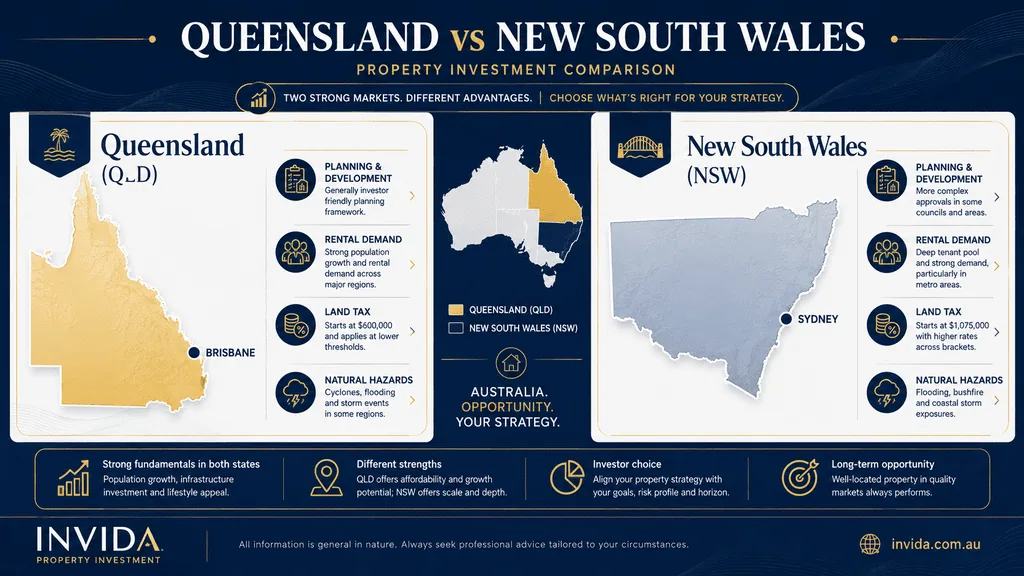
Neither state is automatically safer. The relevant risks depend on the property, council area, ownership structure and intended use.
Area to Review | Queensland | New South Wales |
Planning | Local planning schemes, zoning, overlays and development assessment | LEPs, SEPPs, council controls, zoning and mapped constraints |
Natural hazards | Flood, overland flow, cyclone, storm, bushfire and coastal exposure | Flood, bushfire, storm, coastal exposure and other mapped constraints |
Rental compliance | Residential Tenancies Authority (RTA) minimum housing standards and applicable tenancy requirements | NSW minimum rental standards and applicable tenancy requirements |
Land tax | Queensland thresholds, ownership type and total taxable holdings | NSW thresholds, ownership rules and combined taxable land value |
Insurance | Confirm flood, cyclone, storm and other relevant cover | Confirm flood, bushfire, storm and coastal cover |
Strategy feasibility | Verify intended use and approvals with the relevant council and advisers | Verify permissibility, approval pathway and constraints before purchase |
This comparison is a starting point only. A property investment in Queensland may require different checks from another property in the same suburb, just as two NSW sites can have very different planning or hazard constraints.
Matching a Strategy to Your Risk Profile
Matching your strategy to your risk profile helps ensure that your property investment remains manageable both financially and emotionally. A strategy that involves major renovations, higher borrowing or uncertain approval timeframes may suit an investor with greater financial capacity and tolerance for change, but it could place unnecessary pressure on someone seeking stable income and predictable costs.
By choosing an approach that reflects your cash reserves, investment timeframe, experience and comfort with uncertainty, you are more likely to stay committed to the plan, make measured decisions and avoid taking on risks that could undermine your long-term goals.
Lower-Risk Property Investment Priorities
A lower-risk investor often focuses first on what could go wrong. You may prefer a stable PAYG income, predictable costs, conservative borrowing and a property with clear comparable sales.
That does not mean a unit, townhouse or villa is automatically low risk. Strata costs, building defects, oversupply, limited land content and rental demand all need to be assessed. A lower-risk approach may instead prioritise:
- A stronger cash reserve.
- Established and diverse tenant demand.A manageable loan structure.
- Limited or well-defined building work.
- Professional management.
- More than one possible exit or use.
- Cash flow that is not dependent on strong capital growth.
The downside of an overly cautious approach is analysis paralysis. Research is essential, but eventually the evidence must support a clear decision.
Medium-Risk Investor Priorities
A medium-risk investor usually combines research with a willingness to act. You may be self-employed, comfortable completing a purpose build or conversion, or willing to invest outside your home city when the numbers and support structure make sense.
Possible strategies may include a dual-occupancy property, a secondary dwelling, a carefully assessed conversion or a residential property with multiple income streams. These opportunities can provide additional upside, but they also introduce approval, construction, finance and management considerations.
The goal is not to eliminate every variable. It is to understand the variables, price them into the decision and engage the right specialists before proceeding.
Higher-Risk Investor Priorities
A higher-risk investor may be attracted to sight-unseen purchases, specialised accommodation, speculative locations, major development work, commercial assets or strategies promising unusually high returns.
High tolerance can be valuable when it is supported by experience, research and sufficient financial capacity. It becomes dangerous when the potential return receives all the attention and the downside is ignored.
Before pursuing a higher-risk strategy, test the occupancy assumptions, approval pathway, finance conditions, operating costs and exit market. Being comfortable with risk does not make due diligence optional.
Can Co-Living Reduce Some Investment Risks?
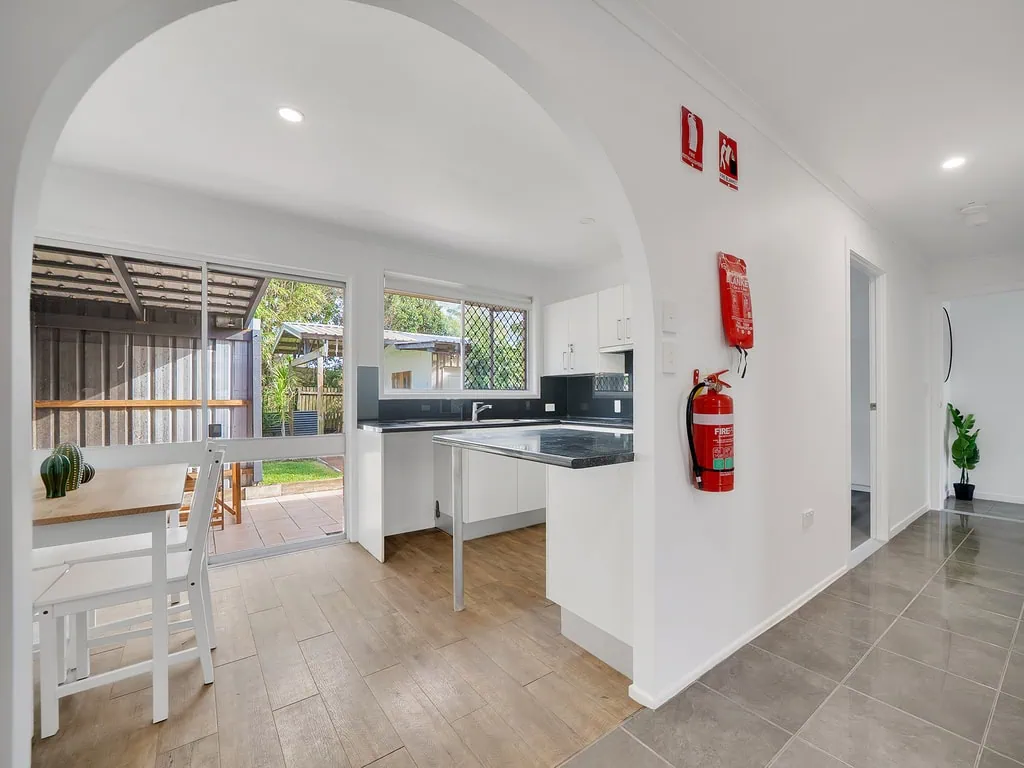
A well-selected and professionally managed co-living property may reduce reliance on a single tenant by creating several separate rental income streams. If one resident leaves, some income may continue from the remaining residents.
That does not make every co-living opportunity low risk. The site must suit the model, local demand needs to be verified, the layout must support tenant privacy and comfort, and all planning, building and tenancy requirements must be understood. Utilities, furnishing, maintenance and specialised management should also be included in the numbers.
For the right investor and property, co-living can provide a balance between stronger income potential and the familiarity of a residential asset. The key is choosing the property and structuring the project properly rather than assuming the strategy alone will produce the result.
Property Investment Risk Checklist Before You Commit
Before signing a contract or proceeding with a project, ask:
- Can I continue holding the property if interest rates or operating expenses increase?
- How long could I cover repayments during a vacancy or construction delay?
- Is tenant demand supported by more than one employment or lifestyle driver?
- Have I reviewed planning controls, zoning and required approvals?
- Have I checked flood, bushfire and other relevant natural-hazard information?
- Have I obtained an insurance indication or quote?
- Have building, renovation or conversion costs been independently reviewed?
- Have I allowed for rates, land tax, utilities, management and maintenance?
- Does the property have a practical alternative use or resale strategy?
- Do the numbers remain workable under a conservative scenario?
An investment property risk assessment is most useful before you become emotionally or financially committed to the deal.
How INVIDA Helps Investors Manage Risk
Successful co-living projects require more than finding a house with enough bedrooms. They involve property assessment, local-demand research, finance, design, approvals, construction, furnishing, tenant placement and ongoing management.
INVIDA brings these stages together through an integrated team of specialists. We can help investors assess a property’s suitability for conversion, plan a custom build, understand the likely project pathway and coordinate the work required to create a functional, attractive co-living home.
For investors considering property investment opportunities in Queensland or New South Wales, having experienced support can make it easier to identify site-specific risks before they become costly problems.
Choose a Strategy That Fits You and the Property
Every risk profile has strengths. Cautious investors can be disciplined and consistent. Medium-risk investors may balance evidence with action. Higher-risk investors can see possibilities others overlook.
The objective is not to force yourself into a different personality. It is to build enough structure around your decisions that your strategy reflects both your goals and your capacity.
If you are considering a co-living conversion or custom build in Queensland or New South Wales, book a strategy call with INVIDA. Our team can help you assess the property, local demand, design potential and project requirements before you move forward.
Disclaimer: This article provides general information only and does not constitute financial, tax, legal, planning or investment advice. Obtain advice from appropriately qualified professionals based on your circumstances and the location of the property.