

What Is Cohousing in Australia?
Cohousing is a residential model where people intentionally form a community, often living in separate homes while sharing facilities such as gardens, kitchens, recreational areas or communal buildings.
Unlike conventional neighbourhoods, residents generally participate in decisions about how their community operates.
A cohousing development might consist of several independently owned townhouses or apartments arranged around communal spaces. Some communities also use cooperative ownership or other collective structures.
The defining feature is the emphasis on shared responsibility and participation rather than simply occupying accommodation with other people.
How Does Cohousing Work?
Cohousing communities commonly involve:
- Individually owned or collectively owned dwellings.
- Shared facilities and communal outdoor spaces.
- Resident involvement in property and community decisions.
- Agreements covering the maintenance and use of common areas.
- An emphasis on social connection, cooperation and long-term community stability.
For people who value shared resources and neighbourhood involvement, this arrangement can be appealing.
However, from an investment perspective, cohousing is not necessarily designed to maximise income from individual rooms.
An investor purchasing a dwelling within a cohousing development may also need to consider community agreements, ownership arrangements and any restrictions affecting how the property can be rented or sold.
These arrangements vary between developments. Cohousing does not automatically prohibit investment ownership or renting, but its structure may be less suited to investors wanting independent control over a property’s rental strategy.
What Are the Advantages and Disadvantages of Cohousing?
Cohousing can provide meaningful benefits for residents. Shared facilities may reduce the need for individual households to purchase certain amenities, while community participation can encourage stronger relationships between neighbours.
There are also potential limitations.
Community decisions may require consultation and agreement between multiple households. Development projects can involve complicated financing or ownership structures, and investors may have less flexibility to change the property’s use independently.
For someone seeking a community-oriented home, these considerations may be acceptable.
For someone whose priority is generating rental income, however, a more investor-directed housing model may be preferable.
What Is Co-Living Property Investment?

Co-living is a housing arrangement where residents rent private accommodation while sharing selected household facilities.
Unlike cohousing, residents generally do not need to participate in the ownership or collective governance of the property.
In a typical co-living property investment, one investor owns the home and receives rental income from multiple residents occupying individual rooms.
Depending on the property’s design, rooms may include private bathrooms, kitchenettes, storage and secure access. Residents can also share a main kitchen, lounge, laundry and outdoor areas.
Professional management can coordinate tenant selection, maintenance, house rules and common-area responsibilities.
For investors, the attraction is the opportunity to improve the income-producing capacity of a single residential asset.
This is why understanding the available co-living housing configurations is an important part of determining whether the strategy suits a particular property.
Why Is Co-Living Attractive to Property Investors?
A conventional rental house generally produces one combined rental payment under a whole-property tenancy.
An appropriately structured co-living home can generate income from several separately rented rooms instead.
For example, consider a property that could rent to one household for $750 per week.
If the same property could legally and economically accommodate five private rooms rented at $300 per week each, the potential gross rental income would be $1,500 per week at full occupancy.
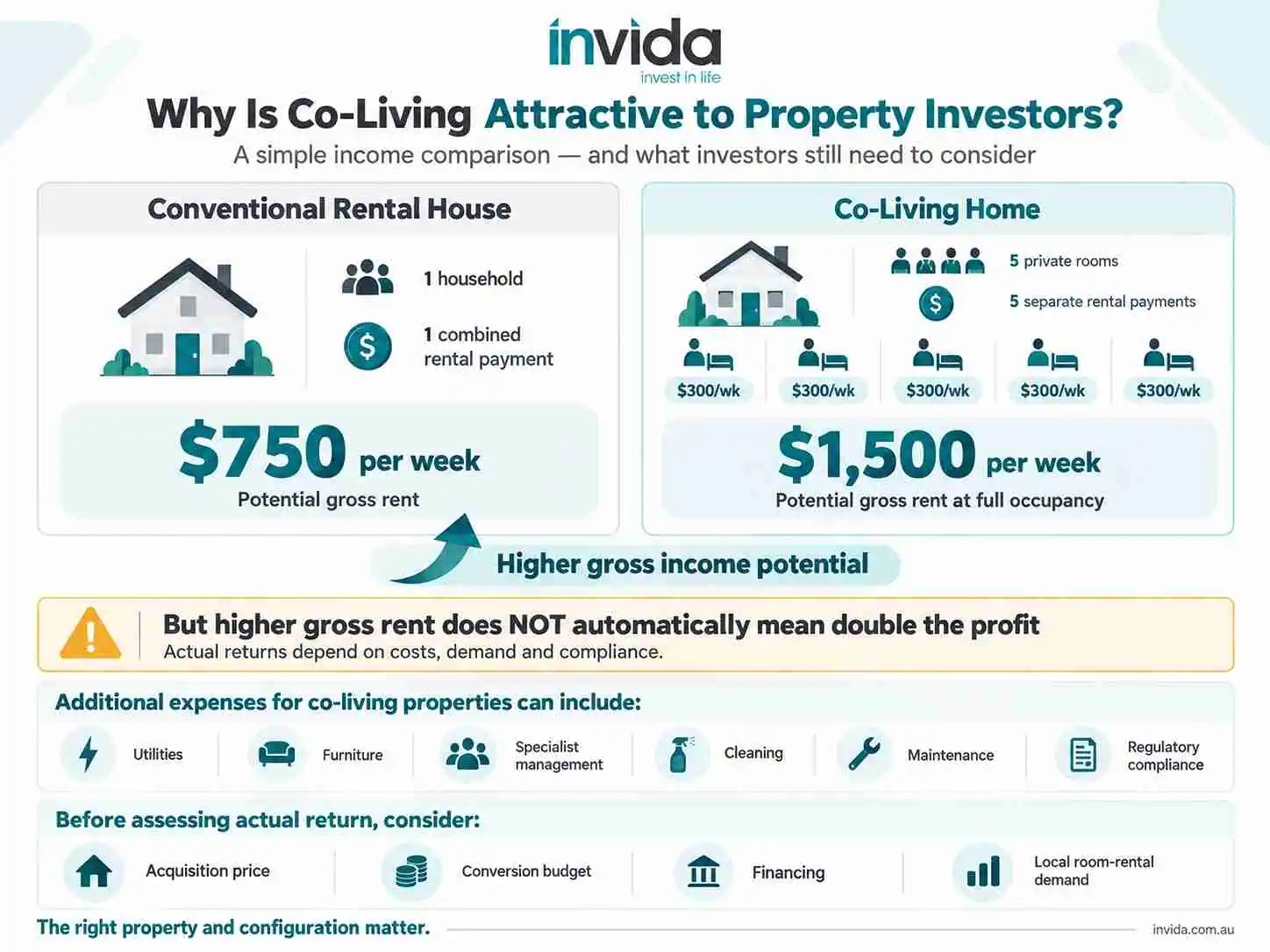
That represents a substantial increase in gross income, but it does not automatically mean the investment is twice as profitable.
Co-living properties can involve additional expenses such as utilities, furniture, specialist management, cleaning, maintenance and regulatory compliance.
The acquisition price, conversion budget, financing and local room-rental demand must all be considered before assessing the actual return.
Cohousing vs Co-Living: What Are the Main Differences?
Although both models incorporate communal living, their underlying purposes are different.
Cohousing is generally built around community participation and shared residential resources. Co-living is typically structured around providing private rental accommodation within a professionally managed property.
For investors comparing cohousing vs co-living, the differences become particularly important when considering property ownership, control and rental performance.
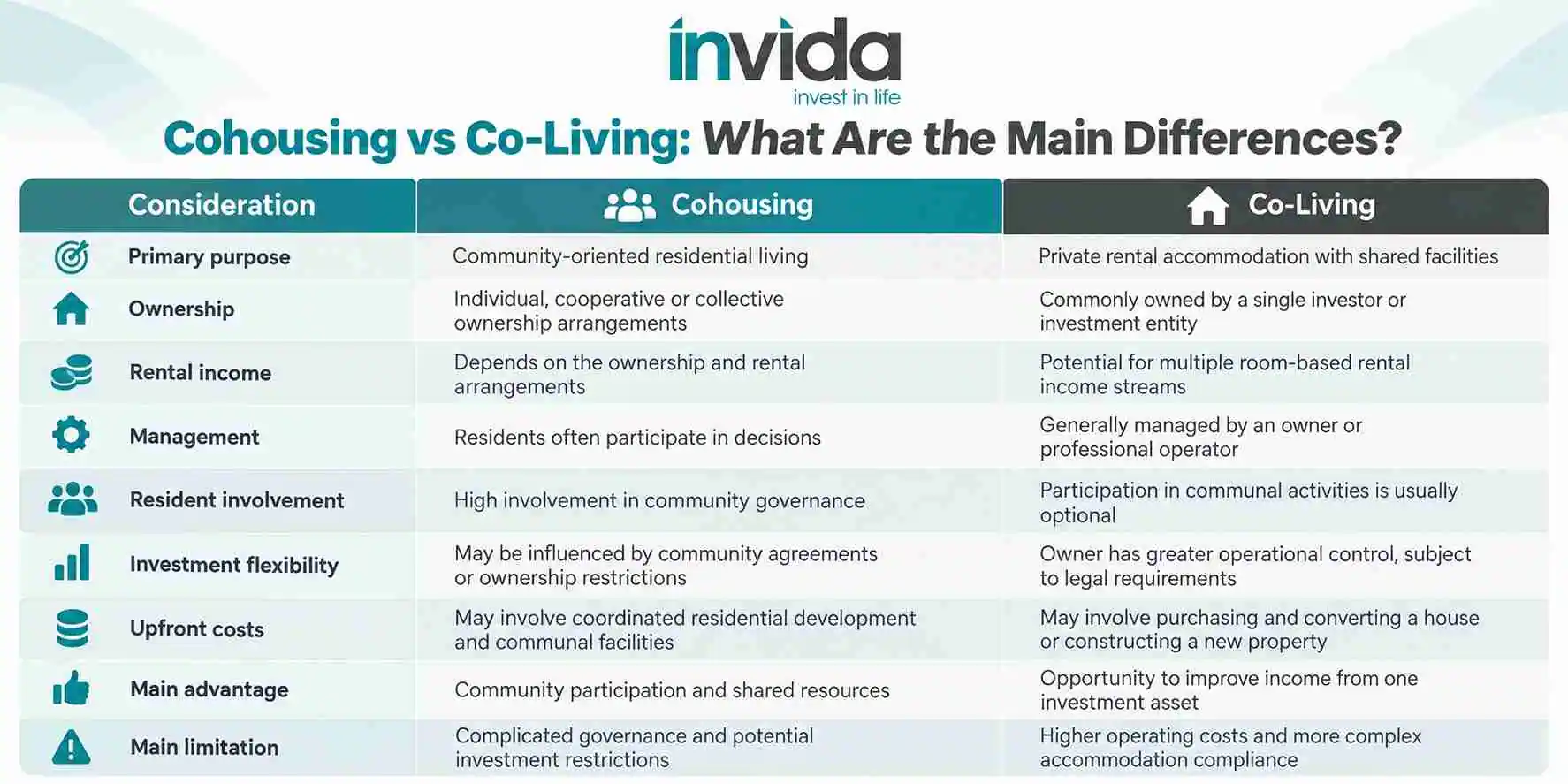
Neither model eliminates property investment risks.
However, co-living more directly supports investors who want an income-producing property without the shared decision-making arrangements commonly associated with cohousing.
Why Co-Living May Be the Better Investment Strategy
Choosing between cohousing and co-living ultimately depends on what you want the property to achieve.
If your priority is becoming part of a collaborative residential community, cohousing may suit your needs.
If your objective is to build an investment portfolio, improve rental cash flow or make better use of an existing residential property, co-living may offer more practical opportunities.
Here are some reasons why.
1. Multiple Income Streams From One Property
One of the main advantages of co-living is the ability to collect rent from several residents rather than relying on one household.
This can also spread vacancy exposure across multiple rooms.
If one room becomes vacant, the remaining occupied rooms may continue generating income.
However, multiple tenancies do not remove vacancy risk. Tenant turnover, room demand and management costs still influence the property’s financial performance.
2. Greater Control Over Property Management
In a co-living arrangement, the owner or appointed manager generally makes decisions about leasing, maintenance and property operations.
This differs from cohousing communities where residents may share responsibility for governance and decisions affecting common facilities.
For investors wanting to maintain control over their asset while outsourcing day-to-day operations, professional co-living management can be particularly useful.
3. Opportunities to Improve Existing Properties
Co-living does not always require purchasing land and constructing a new dwelling.
An existing residential property may be suitable for conversion if its layout, location, building classification and required approvals support the intended use.
Improvements might include adding bathrooms, reconfiguring internal spaces, installing appropriate safety measures or upgrading communal facilities.
This can create opportunities for investors who already own suitable properties.
However, the feasibility of converting an existing house needs to be assessed before work begins.
4. Potential to Support Portfolio Cash Flow
Higher gross rental income can improve an investment property’s ability to contribute to ongoing expenses.
For investors planning to expand their portfolios, that may help support a broader strategy.
Nevertheless, borrowing costs, property valuations, lender policies and individual financial circumstances remain important.
Investors should assess the property’s net income and finance arrangements rather than assuming that stronger gross rent will automatically improve borrowing capacity.
For a closer look at these considerations, see our guide to building a property portfolio with co-living.
5. Accommodation That Appeals to Particular Rental Markets
Co-living may appeal to people who want a private space without paying for an entire dwelling.
This can include professionals relocating for employment, healthcare workers, students and other renters seeking furnished accommodation with convenient access to essential facilities.
However, tenant demand differs between suburbs.
A property that performs well near a major employment centre may not achieve the same occupancy or rental rates in a location with limited demand for individual rooms.
That makes local market research essential.
Which Properties Are Best Suited to Co-Living Investment?
 Understanding cohousing vs co-living is only the beginning. Once you’ve decided that co-living aligns with your investment goals, the next challenge is identifying a property that can support the strategy.
At INVIDA, we believe property selection should begin with suitability rather than projected rental income.
A house advertised with six bedrooms is not necessarily a better opportunity than a four-bedroom home with a more practical layout.
The right investment depends on how the building can be used, what alterations are needed and whether renters genuinely want to live there.
1. Properties Near Employment and Transport
Location remains an important consideration for any co-living investment property in Australia.
Properties near hospitals, business centres, universities, transport connections or major employment areas may appeal to renters who value convenience and access to work.
However, investors should investigate local demand rather than assuming every employment corridor will support premium room rents.
2. Homes With Adaptable Floor Plans
A suitable existing house may allow bedrooms and bathrooms to be reconfigured without major structural changes.
Single-level properties, practical plumbing locations and well-positioned shared spaces can be advantageous.
Homes with complicated internal layouts or extensive structural limitations may require more expensive renovations.
The question is whether the proposed improvements create enough additional income to justify their cost.
3. Properties With Suitable Shared Facilities
Even when residents have private bathrooms or kitchenettes, communal spaces remain important.
A co-living home needs to function comfortably for several people.
That means considering the adequacy of kitchens, laundries, living spaces, storage, parking and outdoor areas.
Overcrowding or poorly planned facilities can create operational difficulties and reduce tenant satisfaction.
4. Properties With a Clear Compliance Pathway
A property may have excellent rental potential but still be unsuitable if the intended use cannot obtain the required approvals.
Before purchasing, investors should investigate the building’s approved use, local planning provisions, applicable overlays and likely upgrade requirements.
Our guide to Class 1b building requirements for co-living provides additional information about how building classifications can affect project design and compliance.
5. Properties Where the Numbers Work After Expenses
Higher rental income is only worthwhile if the financial outcome supports the investment.
Investors should evaluate the purchase price, stamp duty, finance costs, renovation budget, furnishings, utilities, insurance, ongoing maintenance and management fees.
Vacancy assumptions should also be realistic.
When comparing opportunities, look at the total amount invested and the income remaining after expenses rather than focusing exclusively on projected weekly rent.
For a more detailed approach, review the seven things to check before buying a co-living property.
Which Properties Should Co-Living Investors Avoid?

Not every residential property is a suitable candidate for co-living.
Some properties appear attractive because of their size, asking price or advertised rental potential. However, hidden compliance requirements, renovation costs or weak tenant demand can undermine the investment.
Here are some warning signs worth investigating before purchasing.
Properties With Expensive Conversion Requirements
A large house may offer enough space for multiple bedrooms but require substantial upgrades to bathrooms, plumbing, electrical systems or fire-safety measures.
If those improvements cost significantly more than expected, the additional rental income may not justify the project.
Older homes may also contain asbestos, outdated wiring or structural issues that increase the renovation budget.
These risks do not automatically make a property unsuitable, but they should be investigated before committing.
Homes in Locations With Weak Room-Rental Demand
A property may be affordable to purchase without being attractive to prospective co-living residents.
Limited employment opportunities, poor transport connections or insufficient demand for individual rooms can result in longer vacancies.
Investors should consider the number and type of likely tenants, comparable room rental prices and the availability of competing accommodation.
Properties With Restrictive Planning Conditions
Properties affected by planning overlays, heritage protections, unsuitable zoning or other development restrictions may require additional approvals.
These requirements can affect the cost, timing or feasibility of a conversion.
A property should not be purchased on the assumption that room-by-room renting will be permissible simply because similar accommodation exists nearby.
Apartments With Complicated Ownership Arrangements
Apartments may appear suitable because they are located near employment centres and public transport.
However, strata or owners corporation arrangements, the approved building use and the physical configuration may restrict how the accommodation can operate.
Investors should investigate the applicable requirements rather than assuming a centrally located apartment can be converted into co-living.
Properties Marketed on Unrealistic Rental Returns
An advertised rental yield should be treated as a starting point for investigation, not proof of investment performance.
Some projections assume that every room will remain occupied throughout the year or exclude important operating expenses.
Others may rely on room rents that have not been demonstrated in the local market.
At INVIDA, we believe an investment needs to make sense under realistic conditions, including vacancies, operating costs and unforeseen expenses.
Sometimes, deciding not to purchase a property is just as important as identifying the right opportunity.
Should You Convert an Existing Property or Build a Co-Living Home?
Once you’ve decided that co-living is the preferred investment model, another question arises: should you purchase an existing house for conversion or invest in a purpose-built property?
Both strategies can work, but their costs and practical considerations differ.
Converting an Existing Home
An existing property may offer a more accessible entry point where the layout already supports the intended accommodation model.
It can also allow investors to consider established suburbs where vacant land is limited.
However, conversion costs can increase if the original structure requires extensive alterations.
The best opportunities are generally properties where the proposed configuration can be achieved without excessive construction or compliance expenses.
Investing in a Purpose-Built Co-Living Property

A new build allows the property to be designed around multiple residents from the beginning.
This can support better bedroom arrangements, practical communal facilities, appropriate services and consideration of applicable building requirements during design.
However, purpose-built properties may require more upfront capital and involve longer periods before rental income begins.
Construction costs, land selection, builder performance and projected tenant demand are therefore important.
For investors comparing these options, our article on new builds versus co-living conversions explains the advantages and trade-offs of each approach.
The better option is the one that delivers a suitable, compliant property at a total cost supported by realistic rental demand and investment returns.
Cohousing vs Co-Living: Which Offers Better Rental Returns?
When comparing cohousing vs co-living from an investment perspective, rental income is an important consideration.
However, the two models are not designed around the same financial objectives.
A cohousing arrangement may involve individually owned residences within a wider community. The financial performance of an investment dwelling would generally depend on its specific ownership, leasing and community arrangements.
Co-living is more directly structured around renting private accommodation to multiple residents.
This creates opportunities to increase the amount of rent generated by a single property, but it also brings additional expenses.
Example: How Co-Living Income Can Differ
Consider two hypothetical properties:
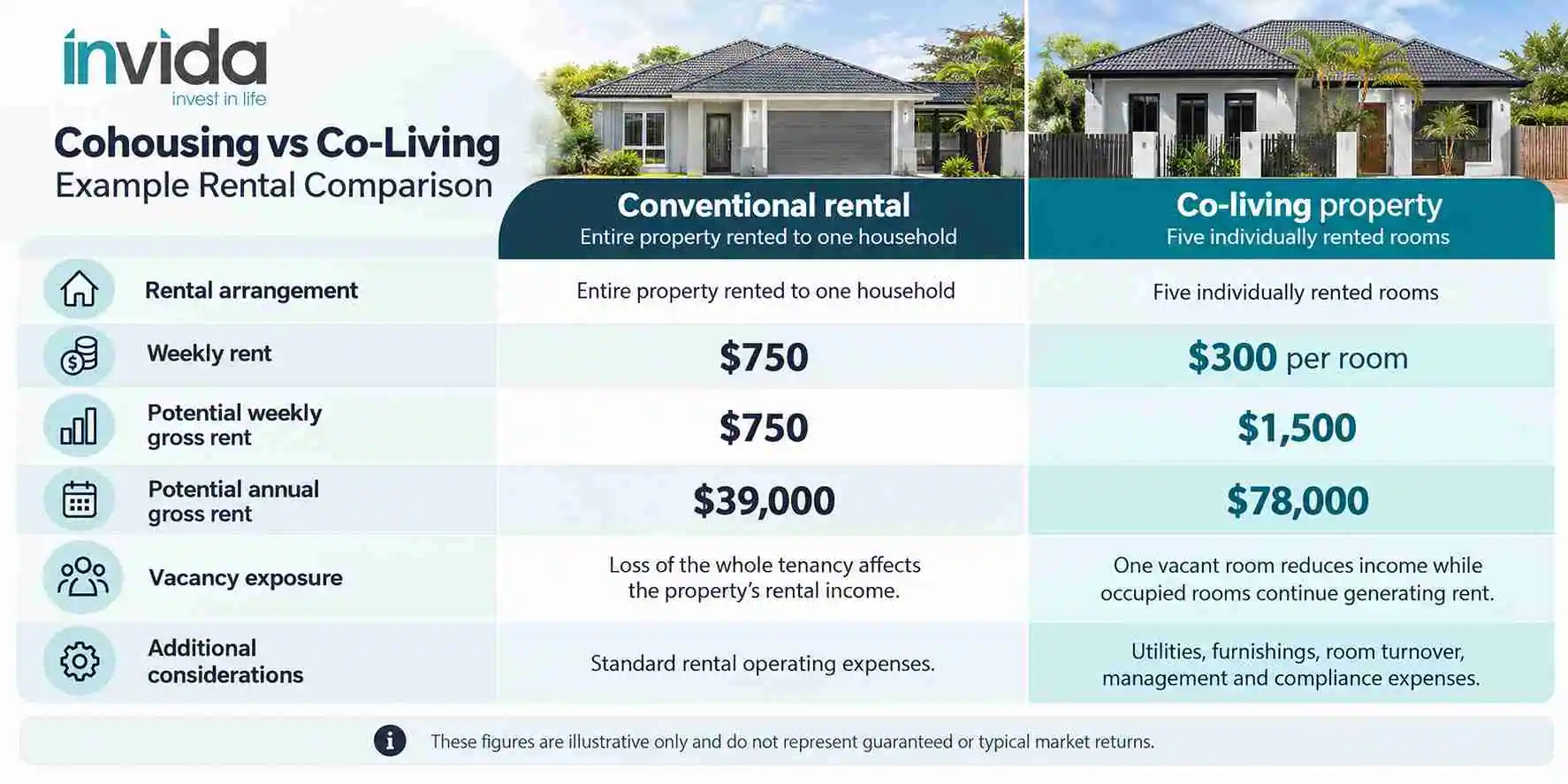
These figures are illustrative only and do not represent guaranteed or typical market returns.
The co-living property produces more potential gross rental income in this example, but the comparison is incomplete without accounting for acquisition and conversion costs, operating expenses, interest and vacancies.
The Australian Government’s property investment guidance explains that investors need to consider borrowing costs, maintenance, management, vacancies and other expenses when assessing residential investment properties.
An investment generating higher rent is not necessarily the better purchase if achieving that income requires substantially more capital or exposes the owner to greater financial risk.
This is why our approach to assessing return on investment for co-living properties considers the broader investment strategy rather than rental income alone.
How INVIDA Helps Investors Choose the Right Co-Living Property
The difference between cohousing and co-living becomes clearer when you consider what each model is intended to achieve.
Cohousing can provide a supportive residential community with opportunities for shared decision-making and resources.
Co-living offers a different proposition: the opportunity to own an income-producing property that accommodates multiple residents while providing private living spaces and shared amenities.
But successful co-living investment is not simply about adding more bedrooms or increasing the number of tenants.
The property’s location, configuration, legal use, conversion costs and operational requirements all need to work together.
At INVIDA, our approach is to help investors assess these considerations before committing to a particular investment.
That can involve evaluating existing properties for conversion, considering purpose-built co-living opportunities and coordinating the relevant expertise needed to understand the project’s potential.
We also recognise that not every property will be appropriate.
A home with an attractive purchase price or impressive projected rental income may still represent a poor investment if the compliance requirements or construction costs make the project uneconomic.
Our objective is to help investors make informed decisions based on the property’s suitability and realistic investment potential.
After all, the best co-living opportunity is not necessarily the property with the most bedrooms. It is the one where the numbers, location, design and legal requirements make sense together.
Make the Right Co-Living Investment Decision With INVIDA
Understanding cohousing vs co-living can help clarify which housing model aligns with your financial objectives.
Cohousing may appeal to people seeking a community-focused residential lifestyle, but co-living is generally more directly suited to investors looking for multiple rental income streams and greater control over an investment property.
Even so, choosing co-living is only the first decision.
The property itself must be suitable for the intended use, located in an area with genuine rental demand and capable of delivering a viable return after all relevant costs.
At INVIDA, we help investors look beyond advertised rental yields and assess the factors that can make or break a co-living investment.
Whether you’re considering converting an existing property or acquiring a purpose-built co-living home, understanding what works before you buy can help you avoid costly mistakes.
Thinking about investing in co-living?
Find out whether your property or potential purchase has the right characteristics for this investment strategy.